Table of Contents
- Quick Answer: Fire Pit Size and Distance at a Glance
- Why Getting Size and Placement Wrong Is a Costly Mistake
- How Many People Do You Want the Fire Pit to Fit
- Matching Fire Pit Size to Your Patio or Yard
- How Far Should a Fire Pit Be From Your House
- How Far Should a Fire Pit Be From a Deck
- How Far Should a Fire Pit Be From a Fence
- Overhead Clearance and Ground Surface Requirements
- Fire Pit Rules in North Carolina and the Southern Pines Area
- DIY Fire Pit vs Professional Installation
- Frequently Asked Questions
- Get Your Backyard Fire Pit Sized and Placed Right
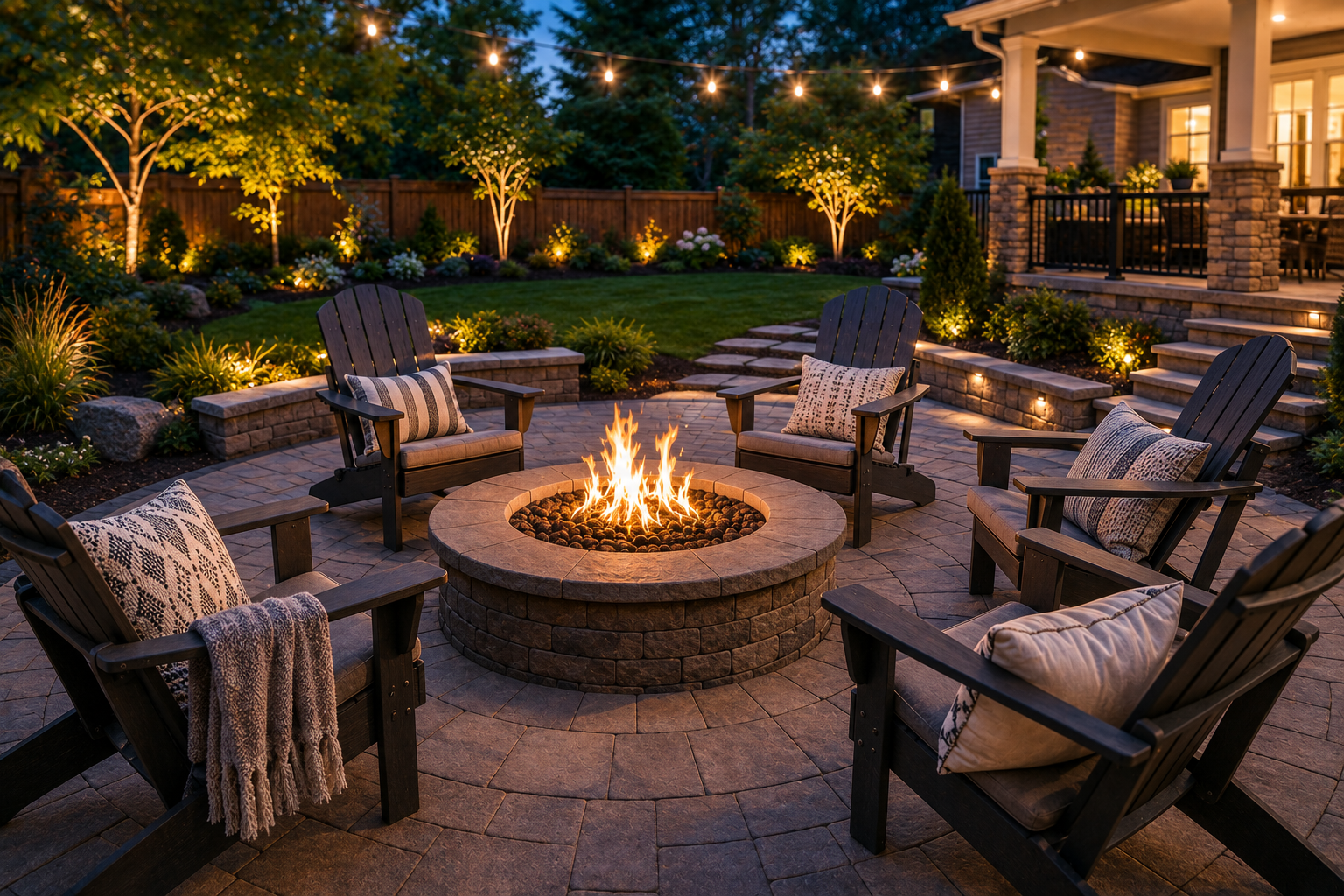
You picture it already. Cool NC evening, string lights on, the fire crackling while everyone pulls their chairs a little closer. That picture is the easy part.
The hard part is what happens before the first flame ever gets lit. How big should this thing actually be? How far does it need to sit from your house, your deck, your fence? Guess wrong and you end up with a fire pit that’s either lost in a huge patio or crammed against a wall it should never be near.
This guide clears that up in one place. No guesswork, no vague “leave some space” advice. Just the real numbers, explained simply, so you can plan a fire pit that’s the right size, in the right spot, the first time.
Fire Pit Size and Distance at a Glance
A fire pit should be 24 to 60 inches in diameter depending on your group size, and sit at least 10 feet from your house, deck, or fence for gas models, and 15 to 25 feet for wood-burning pits. Local codes and manufacturer specs can change these numbers, so always confirm before you build.
| Fire Pit Size | Best For | Minimum Clearance |
| 24-30 in | 2-4 people | 6-8 ft total area |
| 36-44 in | 4-6 people | 8-12 ft total area |
| 48-60 in | 6-10+ people | 12-16 ft total area |
Why Getting Size and Placement Wrong Is a Costly Mistake
Here’s the problem most homeowners run into. They fall in love with a fire pit online, buy it, then realize it either dominates their patio or barely fits four chairs around it.
Placement mistakes are worse. A fire pit set too close to a wood fence can scorch it within a single season. Too close to vinyl siding, and that siding can warp or melt from radiant heat alone, no flying embers required.
Scorched Siding, Melted Vinyl, and Voided Insurance
Radiant heat travels farther than most people expect, especially from wood-burning pits. Vinyl siding can start to warp at surprisingly low temperatures, and many homeowners insurance policies specifically ask about fire pit setback distance before they’ll cover a claim.
HOA Rejections and Failed Inspections
If you’re in a Southern Pines or Sandhills neighborhood with an HOA, fire features often need approval before install. Get the size or placement wrong, and you could be asked to move or remove it after it’s already built.
How Many People Do You Want the Fire Pit to Fit
This is the question to answer first, before you ever look at patio dimensions. Guest count drives size more than anything else.
Small Fire Pits (24-36 in): 2-4 People
A 24 to 36 inch fire pit comfortably seats 2 to 4 people and works well for quiet evenings, small patios, or apartment-style decks. It’s intimate by design, built for close conversation rather than a crowd.
These smaller pits are also easier to keep portable, which is handy if you’re still deciding on a permanent spot in the yard.
Medium Fire Pits (36-48 in): 4-6 People
A 36 to 48 inch fire pit is the most popular size, seating 4 to 6 people while leaving room to walk around it. It strikes the balance most families want: enough heat and presence without swallowing the whole patio.
This is the size GreyFox Outdoor sees requested most often for standard NC backyards, and it pairs well with a mix of lounge chairs and a couple of side tables.
Large Fire Pits (48-60+ in): 6-10+ People
A 48 to 60 inch or larger fire pit is built for entertaining, comfortably seating 6 to 10 or more people around it. These work best in yards with real open space, since the total footprint including seating can stretch past 16 feet across.
If backyard gatherings are a regular thing for your family, this is usually the size worth the investment.
Matching Fire Pit Size to Your Patio or Yard
Guest count tells you the ideal size. Your actual space tells you the maximum size. When the two don’t match, the space wins.
Small Patios and Decks (Under 12×12 ft)
A patio under 12×12 feet works best with a 24 to 30 inch pit. Anything bigger starts eating into walking paths and seating room, which defeats the purpose of a cozy setup.
Mid-Sized Backyards (12×12 to 16×16 ft)
This range comfortably fits a 36 to 44 inch fire pit with room left for four to six chairs. It’s the sweet spot for most single-family NC lots.
Large, Open Backyards (16×16 ft and Up)
Here you have the freedom to go 48 inches or larger without crowding anything. A wide-open yard is also where a custom fire table or masonry surround really gets to shine as a centerpiece.
If you’re pairing your fire tables and fire pits with new seating, measure the full circle, chairs included, not just the pit itself.
How Far Should a Fire Pit Be From Your House
This is the number that matters most for safety, and it changes depending on what you’re burning.
Keep gas fire pits at least 10 feet from your house, and wood-burning fire pits 15 to 25 feet away. Wood-burning pits throw sparks and embers that gas simply doesn’t, which is why they need a much wider buffer.
Wood Burning Fire Pit Clearance
Wood fires pop and send embers airborne, sometimes farther than expected in a breeze. A 15 to 25 foot setback from your home gives that unpredictability somewhere to go besides your siding or roofline.
Gas or Propane Fire Pit Clearance
Gas burns cleaner with no embers involved, so most manufacturers publish a tighter 10 foot minimum from structures. Always check the specific clearance listed for your model, since burner size and BTU output can shift that number.
How Far Should a Fire Pit Be From a Deck
Decks deserve their own conversation, because the deck surface itself is often the combustible material at risk, not just what’s standing on it.
Wood and composite decks need at least 10 feet of clearance from a wood-burning fire pit, and most manufacturers require a fire-rated pad underneath any pit placed directly on decking. Skipping the pad is one of the most common and most dangerous shortcuts homeowners take.
Wood and Composite Decking Rules
Composite decking can look low-risk, but many composite materials still soften or scorch under sustained heat. Treat it the same way you’d treat natural wood when measuring clearance.
Using a Deck-Rated Fire Pit Pad
A fire pit pad creates an air gap that keeps radiant heat from transferring straight into your decking. If you’re set on placing a fire feature on a deck, a gas model with a rated pad underneath is almost always the safer route.
How Far Should a Fire Pit Be From a Fence
Fences sit closer to property lines, which brings a second consideration into play: your neighbor’s yard, not just your own.
Keep fire pits at least 10 feet from wood or vinyl fences, and lean toward 15 feet for wood-burning models. Metal and masonry fences can generally sit a bit closer, since they don’t ignite or soften from heat the way wood and vinyl can.
Wood and Vinyl Fences
These materials are the most vulnerable in your yard. A season of repeated heat exposure, even without direct flame contact, can dry, crack, or warp a wood fence line.
Metal and Masonry Fences
Wrought iron, aluminum fencing, and brick or stone walls tolerate heat far better. You’ll still want reasonable clearance, but the strict 10 to 15 foot rule matters less here than it does with wood or vinyl.
Overhead Clearance and Ground Surface Requirements
Placement isn’t only about what’s beside your fire pit. What’s above it and beneath it matters just as much.
Leave at least 7 to 10 feet of open air above a fire pit, and up to 20 feet if there are overhanging branches. Set the pit on a non-combustible surface like stone, concrete, gravel, or pavers, never directly on grass, mulch, or a wood surface without a rated pad.
Clearance From Branches, Pergolas, and Awnings
If you’re planning a fire feature under a covered pergola or pavilion, overhead clearance rules get stricter, and a gas model is usually the only safe option under a roofed structure.
Choosing a Non-Combustible Base
A gravel bed, paver patio, or poured concrete pad all work well. Avoid placing any fire pit, even a portable one, directly on grass or dry landscaping mulch.
Fire Pit Rules in North Carolina and the Southern Pines Area
General safety numbers are a strong starting point, but North Carolina adds its own layer on top.
North Carolina follows state fire code guidance alongside county-level rules, and many Moore County and Southern Pines neighborhoods have HOA restrictions on top of that. Always check both before you finalize a location.
County and Local Permit Considerations
Some counties require permits for permanent, built-in fire features, while portable gas fire pits often skip that requirement entirely. A quick call to your local fire marshal’s office settles this fast.
HOA Guidelines to Check Before You Build
Sandhills-area HOAs frequently restrict wood-burning fire pits or require specific setback distances beyond the state minimum. Getting this in writing before installation saves you from an expensive redo later.
DIY Fire Pit vs Professional Installation
Once you know your size and setback numbers, one decision remains: build it yourself, or bring in a professional.
A portable gas fire pit on an existing patio is a reasonable DIY project for most homeowners. A permanent, built-in fire feature with masonry, gas lines, or a custom surround is a different story entirely.
That’s where a professional install earns its cost back. Getting gas lines, surface prep, and code clearance right the first time avoids the two most expensive fire pit mistakes: a failed inspection or a feature that has to be relocated. If you want that peace of mind, GreyFox Outdoor’s outdoor living installation team handles the sizing, placement, and setup so nothing gets left to guesswork.
Frequently Asked Questions
How many people fit around a 36 inch fire pit?
A 36 inch fire pit comfortably seats 4 to 6 people with room for chairs and walking space around the edge. It’s the most versatile size for typical family backyards.
Can you put a fire pit on a wood deck?
Wood-burning fire pits should not go directly on a wood deck under any circumstances. A gas fire pit can sit on a wood deck only with a fire-rated pad and at least the manufacturer’s minimum clearance.
How far does a fire pit need to be from a property line?
Most local codes require 10 to 15 feet of setback from a property line, though this varies by county and HOA. Check your specific municipal fire code before placing a permanent fire feature.
Do gas fire pits need less clearance than wood-burning ones?
Yes. Gas fire pits typically need only 10 feet from structures since they produce no embers, while wood-burning pits need 15 to 25 feet due to spark and ember risk.
Get Your Backyard Fire Pit Sized and Placed Right
A fire pit should make your backyard feel bigger, not riskier. Get the size right and it becomes the spot everyone gravitates toward. Get the placement right and you never have to think twice about safety while it’s burning.
If you’d rather skip the measuring tape and code lookups, GreyFox Outdoor can walk your yard, recommend the right size, and handle the install from start to finish. Browse our fire pits gallery for inspiration, or reach out to our team to talk through what fits your space.