Table of Contents
- Why National Pergola Material Guides Fail NC Homeowners
- Why NC Climate Makes Pergola Material Selection Different
- Vinyl Pergola Lifespan in NC Conditions
- Wood Pergola Lifespan in NC Conditions
- Aluminum Pergola Lifespan in NC Conditions
- Side-by-Side NC Lifespan Comparison
- Maintenance Commitment Comparison for NC Conditions
- True Cost Over Lifespan for NC Homeowners
- Which Pergola Material Fits Which NC Homeowner Situation
- Ready to Choose Your NC Pergola Material at GreyFox Outdoor?
- Frequently Asked Questions About Pergola Lifespan in NC
- Visit GreyFox Outdoor in Southern Pines to Choose Your NC Pergola
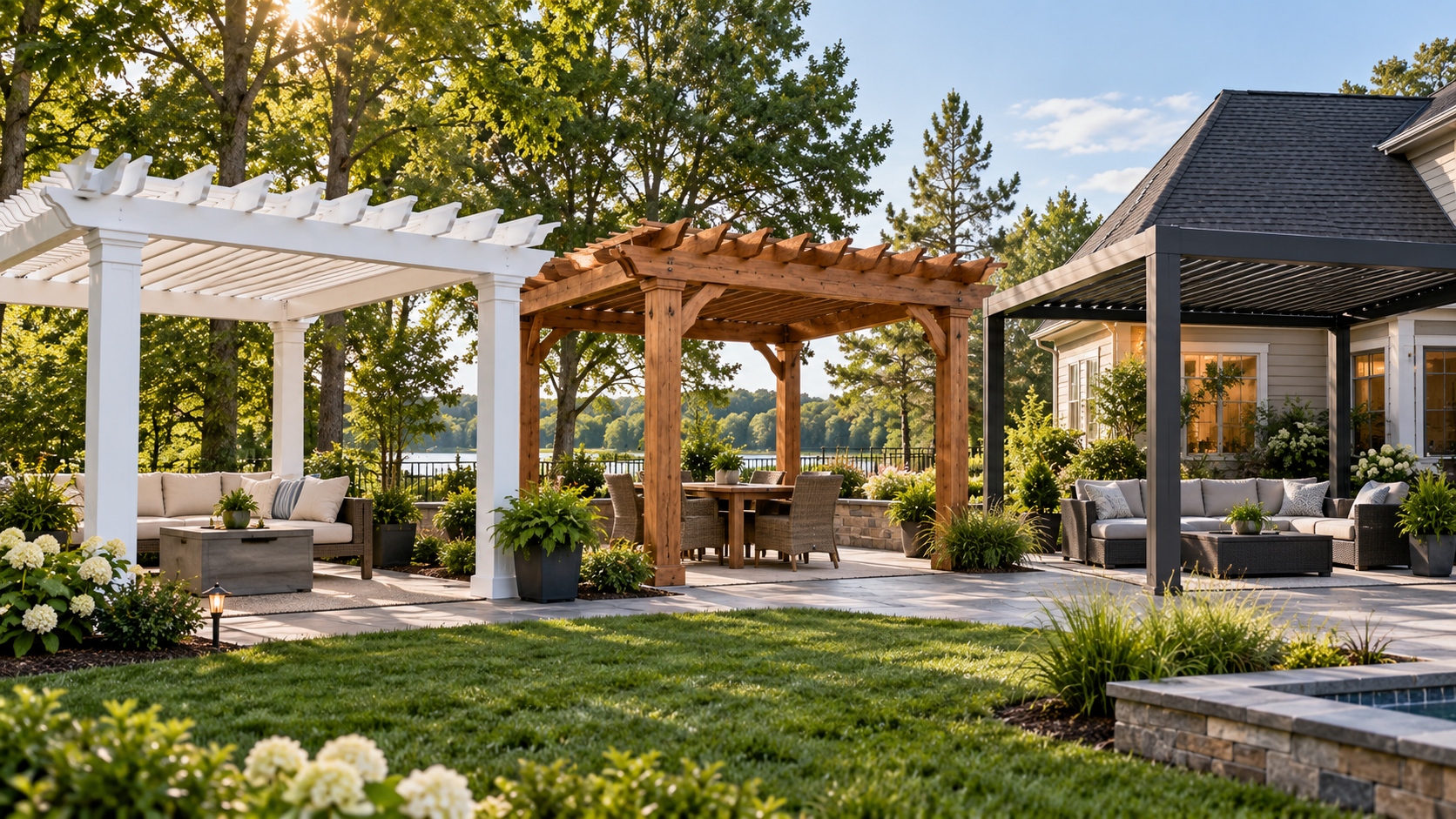
You are comparing vinyl, wood, and aluminum pergolas for your Southern Pines or Aberdeen backyard. Every guide you find tells you wood pergolas last 15 to 25 years, vinyl lasts 20 to 30 years, and aluminum lasts a lifetime. The problem is these numbers are built on climate assumptions that have nothing to do with North Carolina.
NC Sandhills humidity, intense summer UV, February through May pollen season, and coastal moisture influence produce a material performance environment that changes every one of those national estimates. A cedar pergola that performs for 20 years in Colorado will perform for 10 to 15 in the Sandhills without meticulous annual maintenance. Vinyl that holds color brilliantly in Seattle fades faster in NC’s UV intensity.
This guide gives you NC-specific lifespan ranges, honest maintenance requirements for each material, and a true 20-year cost calculation that tells you what you are actually investing before you commit to a material.
Visit GreyFox Outdoor at 225 W Morganton Rd C, Southern Pines or call +1 910-725-0394 to see all three material types in our outdoor structures showroom.
Why National Pergola Material Guides Fail NC Homeowners
The Climate Assumption Problem in Generic Pergola Comparisons
National pergola material guides build their lifespan estimates on climate conditions that represent a national average rather than any specific region. That average does not include NC Sandhills summer humidity readings that create biological growth conditions on wood surfaces. It does not include the UV intensity of extended NC summers that accelerate vinyl color degradation faster than northern markets experience. And it does not include the specific organic load that NC pollen season deposits on all outdoor surfaces for four months every year.
What NC Sandhills Conditions Actually Do to Pergola Materials
The Sandhills outdoor environment creates three specific material challenges: prolonged high humidity during spring and summer that creates conditions for wood degradation and biological surface growth, UV exposure during the extended NC outdoor season that is more intense and more prolonged than northern climates, and the most significant pollen season in the Southeast that deposits organic material on every outdoor surface from February through May.
Each of these conditions affects vinyl, wood, and aluminum differently. Understanding how requires NC-specific data rather than national averages.
Why NC Climate Makes Pergola Material Selection Different
NC Sandhills climate creates three material performance challenges that national guides underestimate for all three pergola materials: humidity above 80 percent during spring and summer accelerates wood degradation and biological surface growth significantly faster than dry or moderate climates, UV intensity during NC’s extended outdoor season fades vinyl color and degrades surface integrity faster than northern markets experience, and the Sandhills pollen season creates surface organic load conditions that increase cleaning requirements for all three materials with meaningful differences between them.
The NC Humidity Factor That Accelerates Wood Degradation
Wood expands and contracts with moisture cycling. In NC’s Sandhills climate where summer humidity regularly exceeds 80 percent before dropping significantly in dry winter periods, this moisture cycling is more extreme than in moderate coastal or northern climates. This cycling accelerates the checking, splitting, and joint movement that ultimately leads to wood structural degradation. Annual treatment compliance is essential but even maintained NC wood pergolas experience this cycling stress.
The UV Exposure Factor That Affects Vinyl Performance
NC’s latitude and extended outdoor season combine to create UV exposure levels that are meaningfully above what northern markets experience. Vinyl contains UV stabilizers that resist photodegradation, but the stabilizer effectiveness is finite and is consumed over time by UV exposure. NC’s UV intensity means this stabilizer consumption happens faster than in markets that national lifespan guides typically reference.
The Pollen and Organic Growth Factor Unique to NC Conditions
The Sandhills pollen season is among the most intense in the Southeast, coating every outdoor surface in yellow-green organic material from February through May. This organic load creates surface conditions that favor biological growth including algae and mold on wood surfaces, tests the cleaning properties of all three materials annually, and when not consistently cleaned creates a surface degradation accelerant on less resistant materials.
Vinyl Pergola Lifespan in NC Conditions
A quality vinyl pergola in NC Sandhills conditions realistically lasts 15 to 25 years depending on UV stabilizer quality, installation quality, and maintenance consistency. The lower end of this range reflects lower-grade vinyl with basic UV stabilization in high UV exposure positions. The upper end reflects premium vinyl with advanced UV stabilization, proper installation, and consistent annual cleaning. Vinyl’s NC-specific advantage is its resistance to the moisture cycling that accelerates wood degradation.
The Realistic Vinyl Pergola Lifespan for NC Sandhills Homeowners
Unlike wood, vinyl does not respond to NC’s humidity cycling with the same structural consequences. It does not absorb moisture, swell, check, or split in the way wood does under repeated exposure to NC’s summer humidity and dry winter periods. This specific advantage makes vinyl a better moisture-resistance performer in NC than its national lifespan numbers suggest relative to wood.
The NC-specific challenge for vinyl is UV rather than moisture. Full sun positions on south and west-facing NC backyards produce UV exposure that fades and chalks vinyl surfaces faster than shaded or north-facing positions. Quality vinyl pergolas with premium UV stabilizers in full sun NC positions will maintain appearance for 15 to 20 years. Lower-grade vinyl in the same position may show significant color shift and surface chalking within 8 to 12 years.
What NC UV Exposure Does to Vinyl Color and Structural Integrity
Vinyl’s structural properties are minimally affected by UV exposure within its expected lifespan. Color fading and surface chalking are the primary visible consequences. A vinyl pergola that has lost significant color integrity but remains structurally sound is still performing its functional purpose, but the aesthetic impact can make a 15-year-old vinyl pergola look significantly older than an equivalent aluminum structure.
Wood Pergola Lifespan in NC Conditions
Wood pergola lifespan in NC Sandhills conditions ranges from 8 to 18 years depending on wood species, treatment compliance, and exposure. Pressure treated pine with consistent annual treatment achieves 12 to 18 years in NC conditions. Cedar in full NC humidity exposure with consistent treatment achieves similar ranges. Untreated or under-treated wood pergolas in NC humidity degrade significantly within 5 to 10 years regardless of species. NC’s moisture cycling is the primary wood lifespan variable.
How NC Moisture Cycles Affect Different Wood Species
Pressure treated pine: The most common and cost-accessible wood pergola material. Treatment extends resistance to biological degradation but does not eliminate the structural consequences of NC’s moisture cycling. Expect 12 to 18 years with consistent annual sealing and treatment.
Cedar: Naturally higher oil content provides modest additional resistance to biological degradation relative to untreated pine. In NC conditions, cedar’s advantage narrows significantly compared to its performance in dry western climates. Expect 10 to 16 years with consistent treatment.
Hardwood species: Higher density hardwoods including ipe and teak outperform cedar and pine in NC conditions but require the same consistent treatment to achieve their potential NC lifespan of 15 to 20 years at the upper end.
What Annual Treatment Compliance Means for NC Wood Pergola Life
A NC wood pergola that receives consistent annual cleaning, sanding where needed, and appropriate oil or sealant treatment before the humid season begins will achieve the upper range of its species-specific lifespan. A wood pergola that misses two to three treatment seasons in NC’s humidity conditions begins degrading at an accelerated rate that is very difficult to reverse. The maintenance window for NC wood pergolas is not forgiving.
Aluminum Pergola Lifespan in NC Conditions
A quality powder-coated aluminum pergola in NC Sandhills conditions realistically lasts 30 to 50 years or more. Aluminum does not respond to moisture cycling with structural degradation, does not support biological growth on its surface, is not affected by NC UV exposure at the structural level, and requires only annual cleaning to maintain both function and appearance throughout its NC lifespan. Aluminum is the longest-lasting pergola material in NC conditions by a significant margin over both vinyl and wood.
Why Aluminum Outperforms Both Vinyl and Wood in NC Specific Conditions
Aluminum’s advantage in NC conditions is structural: it is unaffected by the moisture cycling that degrades wood and the UV stabilizer consumption that eventually affects vinyl. NC humidity does not cause aluminum to expand and contract with the structural consequences that wood experiences. NC UV does not degrade aluminum’s structural integrity. Biological growth finds no substrate on powder-coated aluminum the way it does on wood grain.
The Powder Coating Factor That Determines NC Aluminum Longevity
Quality powder-coated aluminum pergolas maintain both structural integrity and appearance through NC conditions for decades. The powder coating itself is the element most affected by extended UV exposure, which can produce some color shift over 20 to 30 years in direct sun positions. This is an aesthetic consideration rather than a structural one. Structural integrity remains unaffected throughout.
Lower-quality powder coating applied over inadequate surface preparation will chip and allow moisture penetration at the chip point, which can create localized corrosion. Quality powder-coated aluminum from established manufacturers does not carry this risk at the coating specifications they apply.
What NC Conditions Cannot Do to Quality Aluminum Pergola Construction
NC humidity cannot structurally degrade aluminum. NC UV cannot affect aluminum structural integrity. NC pollen season cleans from aluminum with a garden hose. NC temperature swings do not cause aluminum to check or split. The conditions that create the most uncertainty in wood and vinyl lifespan estimates are largely irrelevant to quality aluminum pergola performance.
For the complete outdoor structures comparison covering pergola versus gazebo versus pavilion for NC homeowners, our guide on pergola vs gazebo vs pavilion which outdoor structure is right for NC covers the structure type decision that precedes the material selection.
Side-by-Side NC Lifespan Comparison
In NC Sandhills conditions, aluminum pergolas last significantly longer than both vinyl and wood: aluminum 30 to 50 or more years, vinyl 15 to 25 years, wood 8 to 18 years depending on species and treatment compliance. The gap between aluminum and wood in NC conditions is wider than in national guides because NC’s humidity cycling specifically accelerates wood degradation while leaving aluminum unaffected.
NC Pergola Material Lifespan Quick Reference Table
| Material | NC Lifespan Range | Primary NC Limiting Factor | Maintenance Impact on Lifespan |
| Vinyl | 15 to 25 years | UV stabilizer consumption | Low: consistent cleaning extends upper range |
| Wood (pressure treated) | 12 to 18 years | Moisture cycling and biological growth | High: missed treatment seasons significantly reduce lifespan |
| Wood (cedar) | 10 to 16 years | Moisture cycling in NC humidity | High: same as pressure treated |
| Aluminum (powder coated) | 30 to 50 or more years | Powder coat UV shift (aesthetic only) | Very low: annual cleaning sufficient |
Maintenance Commitment Comparison for NC Conditions
Wood pergolas require the highest NC maintenance commitment at 4 to 8 hours per year including annual cleaning, inspection, sanding where needed, and oil or sealant treatment. Vinyl requires 1 to 2 hours per year of seasonal cleaning including NC pollen season washing. Aluminum requires 1 to 2 hours per year of cleaning with no treatment, sealing, or structural maintenance. The maintenance commitment gap between wood and aluminum is the single largest practical difference for NC homeowners in the Sandhills.
Annual Maintenance Time and Cost Quick Reference Table
| Material | Annual Hours | Annual Supply Cost | NC-Specific Challenges |
| Wood | 4 to 8 hours | $50 to $200 in treatment supplies | Pollen cleaning, sanding, oil treatment, inspection for checking |
| Vinyl | 1 to 2 hours | Minimal, soap and water | Pollen cleaning, periodic pressure wash |
| Aluminum | 1 to 2 hours | Minimal, soap and water | Pollen cleaning only |
The wood maintenance commitment is not merely more time. It requires specific timing. NC wood pergola treatment is most effective when applied after thorough cleaning in early spring before the humid season begins. A homeowner who consistently performs this treatment in April will achieve the upper range of their wood pergola’s NC lifespan. A homeowner who skips two or three spring treatments in succession will find the wood has progressed beyond the point where treatment can restore it to its original condition.
True Cost Over Lifespan for NC Homeowners
Over 20 years in NC conditions, the true cost of each pergola material including initial investment, maintenance, and replacement cycles often makes aluminum the lowest total cost option despite its higher upfront price. A vinyl pergola requiring replacement at year 18 in NC conditions produces a higher 20-year total cost than an aluminum pergola that requires no replacement. Wood’s high maintenance cost and potentially shorter NC lifespan produce the highest 20-year total cost for most NC homeowners.
The True 20-Year Cost Calculation for Each Pergola Material in NC
Example scenario: 12×12 pergola, Southern Pines NC backyard
Vinyl:
- Initial cost: $4,000 to $7,000
- Annual maintenance: $50 (cleaning supplies)
- 20-year maintenance total: $1,000
- Potential replacement at year 18: $5,000 to $8,000 (labor and materials at future pricing)
- 20-year true cost: $10,000 to $16,000
Wood (cedar):
- Initial cost: $3,500 to $6,000
- Annual maintenance: $150 supplies plus 6 hours labor
- 20-year maintenance total: $3,000 in supplies
- Potential replacement at year 14 to 16: $5,000 to $8,000
- 20-year true cost: $11,500 to $17,000
Aluminum:
- Initial cost: $6,000 to $12,000
- Annual maintenance: $30 (cleaning supplies)
- 20-year maintenance total: $600
- Replacement: not required within 20 years in NC conditions
- 20-year true cost: $6,600 to $12,600
The aluminum upfront premium disappears in the 20-year calculation for most NC homeowners. The lower initial cost of wood or vinyl produces a comparable or higher total investment over the ownership horizon when replacement cycles and maintenance costs are included.
Which Pergola Material Fits Which NC Homeowner Situation
Choose Vinyl If Your NC Situation Matches These Criteria
Vinyl is the right choice for NC homeowners who: have a moderate budget that does not accommodate aluminum, plan to remain in the home for 10 to 15 years rather than a longer horizon, want minimal maintenance without wood’s annual treatment requirement, and are placing the pergola in a partially shaded position that reduces UV exposure and extends vinyl’s NC lifespan toward the upper range.
Choose Wood If Your NC Situation Matches These Criteria
Wood is appropriate for NC homeowners who: are committed to the natural wood aesthetic that vinyl and aluminum cannot genuinely replicate, are willing and able to perform consistent annual treatment without exception, have a budget-priority situation where wood’s lower upfront cost is the decisive factor, or are planning the pergola as a shorter-term structure before a larger outdoor living renovation.
Choose Aluminum If Your NC Situation Matches These Criteria
Aluminum is the right choice for NC homeowners who: plan long-term ownership of 15 or more years in their Southern Pines or Aberdeen home, want the lowest total maintenance commitment over the NC outdoor season, are willing to invest the higher upfront cost in exchange for a structure that does not require replacement within their expected ownership horizon, or have placed the pergola in a full-sun NC position where vinyl’s UV exposure limitation would accelerate the lower end of its lifespan range.
NC Homeowner Pergola Material Quick Match Table
| NC Homeowner Situation | Recommended Material | Primary Reason |
| Budget priority, short ownership | Wood or vinyl | Lower upfront cost |
| Long-term ownership 15 or more years | Aluminum | 20-year true cost advantage |
| Minimal maintenance priority | Aluminum or vinyl | No annual treatment required |
| Natural wood aesthetic priority | Wood | Neither vinyl nor aluminum replicates it |
| Full sun south-facing position | Aluminum | UV resistance advantage over vinyl |
| Partial shade position, moderate budget | Vinyl | UV limitation less relevant in shaded position |
Ready to Choose Your NC Pergola Material at GreyFox Outdoor?
GreyFox Outdoor carries vinyl, wood, and aluminum pergola options at our Southern Pines showroom with structures selected for NC Sandhills outdoor living conditions.
Visit us at 225 W Morganton Rd C, Southern Pines or call +1 910-725-0394 to see all three material types and discuss which fits your specific NC backyard situation and ownership horizon.
Explore our complete outdoor structures and pergola collection for every material type and size available for NC backyards.
Frequently Asked Questions About Pergola Lifespan in NC
How long does a vinyl pergola last in NC?
A quality vinyl pergola in NC Sandhills conditions realistically lasts 15 to 25 years depending on UV stabilizer quality, installation quality, and position. Full sun positions accelerate UV stabilizer consumption and produce the lower end of this range. Partially shaded positions with quality vinyl construction achieve the upper range. Annual cleaning maintains appearance but does not meaningfully extend the UV-limited lifespan.
Which pergola material lasts longest in NC?
Aluminum lasts significantly longer than both vinyl and wood in NC Sandhills conditions, with a realistic lifespan of 30 to 50 years or more for quality powder-coated construction. NC’s humidity cycling and UV exposure that limit vinyl and wood lifespan have minimal effect on aluminum structural integrity. Aluminum is the longest-lasting pergola material in NC conditions by a significant margin.
How long does a wood pergola last in NC humidity?
A wood pergola in NC Sandhills humidity lasts 8 to 18 years depending on wood species and maintenance compliance. Pressure treated pine and cedar with consistent annual treatment achieve 12 to 18 years. Under-maintained or untreated wood in NC humidity degrades significantly within 5 to 10 years. NC’s humidity cycling produces more rapid degradation than national guides estimate based on moderate climate performance.
Is a vinyl or aluminum pergola better for NC backyards?
Aluminum outperforms vinyl in NC conditions over a 15 to 20 year ownership horizon in both lifespan and true total cost. Vinyl is appropriate for homeowners with shorter ownership plans or budget constraints that preclude aluminum. Aluminum’s higher upfront cost is offset by its longer lifespan and minimal maintenance requirements in NC conditions when calculated over a realistic 20-year ownership period.
Does NC pollen damage pergola materials?
The NC pollen season does not cause structural damage to any of the three pergola materials but creates surface accumulation that requires consistent cleaning to prevent biological growth conditions on wood surfaces. Aluminum and vinyl clean efficiently with a garden hose. Wood requires more thorough cleaning before annual treatment application to prevent pollen residue from trapping moisture against the wood surface.
Visit GreyFox Outdoor in Southern Pines to Choose Your NC Pergola
The NC lifespan ranges are specific. The maintenance commitment is quantified. The 20-year cost calculation is complete. The situation-specific recommendation is in the quick match table.
GreyFox Outdoor serves Southern Pines, Aberdeen, and Moore County homeowners from our showroom at 225 W Morganton Rd C, Southern Pines, NC 28387 with pergola options in all three material categories selected for NC Sandhills outdoor living conditions.
Call +1 910-725-0394 or browse our outdoor structures products to see every pergola option available for NC backyards.
For NC homeowners also comparing outdoor furniture materials for the space beneath their new pergola, our guide on poly lumber vs aluminum vs teak outdoor furniture in North Carolina covers the furniture material decision with the same NC climate calibration.
The pergola material you choose today will either serve your Southern Pines or Aberdeen backyard for decades or require replacement within your expected ownership horizon. The NC-specific lifespan data is now in your hands.