Table of Contents
- What a Sandhills Winter Really Feels Like Outdoors
- How Patio Heaters Work
- How Fire Pits Work
- Patio Heaters vs Fire Pits: Side-by-Side Comparison
- Which Works Best for Your Patio Setup?
- Burn Bans and Local Rules to Keep in Mind
- The Best of Both: How to Layer Heat for All-Winter Comfort
- Winter Heating Safety Tips
- Ready to Warm Up Your Patio?
- Frequently Asked Questions About Patio Heaters and Fire Pits
- Enjoy Your Patio All Winter With GreyFox Outdoor
Every year, it happens the same way.
Linda and Mark loved their Southern Pines patio. Morning coffee in the spring. Long dinners in the summer. Glasses of wine on crisp October evenings.
Then Thanksgiving arrived. The cushions went into storage. The chairs sat empty. For four months, they looked at their beautiful patio through the kitchen window.
One December afternoon, it was 58 degrees and sunny. Perfect weather. By 6 PM, the temperature dropped, the wind picked up, and they were back inside.
“Why do we only use this space half the year?” Linda asked.
It’s a great question. And in the Sandhills, the answer is usually simple. Your patio doesn’t need warmer weather. It needs the right heat.
This guide compares patio heaters vs fire pits so you can choose the best way to keep your patio warm through a Sandhills winter. You’ll learn how each option works, which fits your setup, how burn bans affect your choice, and how to layer heat for comfort all season long.
Ready to enjoy your patio year-round? Call GreyFox Outdoor at (910) 725-0394.
What a Sandhills Winter Really Feels Like Outdoors
Winters in the Sandhills are mild compared to much of the country. In Southern Pines, January averages highs near 53°F and lows near 31°F. Many afternoons are pleasant outside, but evenings cool quickly. With the right heat source and some wind protection, most homeowners can use their patios comfortably through the winter months.
Mild Afternoons, Chilly Evenings
Sunny winter afternoons here often feel great. But once the sun sets, temperatures fall fast.
That evening chill is exactly when most people want to be outside, for dinner, a fire, or a quiet drink after work.
Why Wind Matters More Than Temperature
The wind makes the cold feel colder. Winter breezes in Southern Pines average around 6 miles per hour, and open patios, especially on golf course lots, can feel much cooler than the thermometer says.
Blocking the wind can make as much difference as adding heat.
How Patio Heaters Work
Patio heaters produce focused warmth for people sitting nearby. Most outdoor heaters use radiant heat, which warms people and surfaces rather than the air around them. Common types include freestanding propane heaters, tabletop heaters, natural gas heaters, and electric infrared heaters mounted on walls or ceilings.
| Heater Type | Fuel | Best For | Notes |
| Freestanding | Propane | Open patios, flexible layouts | Portable, needs tank refills |
| Tabletop | Propane | Small patios, dining tables | Compact, smaller heat zone |
| Fixed gas | Natural gas | Permanent setups | Requires a gas line |
| Wall or ceiling mount | Electric infrared | Covered patios and porches | Needs electrical access |
Radiant Heat That Warms People, Not Air
Radiant heat works like the sun. It warms what it reaches, including you, your chair, and the floor around you.
That’s why patio heaters can feel effective even on breezy evenings, as long as you’re within their heat zone.
Pros and Cons of Patio Heaters
Pros:
- Strong, focused warmth
- Instant on and off
- No smoke, sparks, or ashes
- Some types work well on covered patios
Cons:
- Less ambiance than a real fire
- Heat zone can be limited
- Propane tanks need refilling
Explore our patio heaters to see options in person.
How Fire Pits Work
Fire pits create warmth and atmosphere with an open flame. Wood-burning fire pits deliver crackling fires and real woodsmoke, while smokeless designs reduce smoke. Gas fire pits and fire tables offer instant flames with easy control. Fire pits warm people sitting around them and become the natural centerpiece of an outdoor space.
Wood Fire Pits and Smokeless Options
Wood fires bring the sounds and smells many people love. Smokeless designs improve airflow to burn wood more completely, reducing the smoke that drifts into your eyes and toward your neighbors.
Explore Breeo smokeless fire pits for real wood fires with less smoke.
Gas Fire Pits and Fire Tables
Gas fire pits offer flames at the turn of a knob. No wood to stack. No ashes to clean. Many fire tables also double as a surface for drinks and snacks.
For a full breakdown of fuel types, read our guide to gas fire pit vs wood-burning fire pit in NC.
Pros and Cons of Fire Pits
Pros:
- Beautiful ambiance and a natural gathering spot
- Warmth for a circle of people
- Wood options can cost less to fuel
Cons:
- Heat mostly reaches the front of your body
- Wood fires produce smoke and embers
- Wood fires take time to start and fully put out
- May be restricted during burn bans
Patio Heaters vs Fire Pits: Side-by-Side Comparison
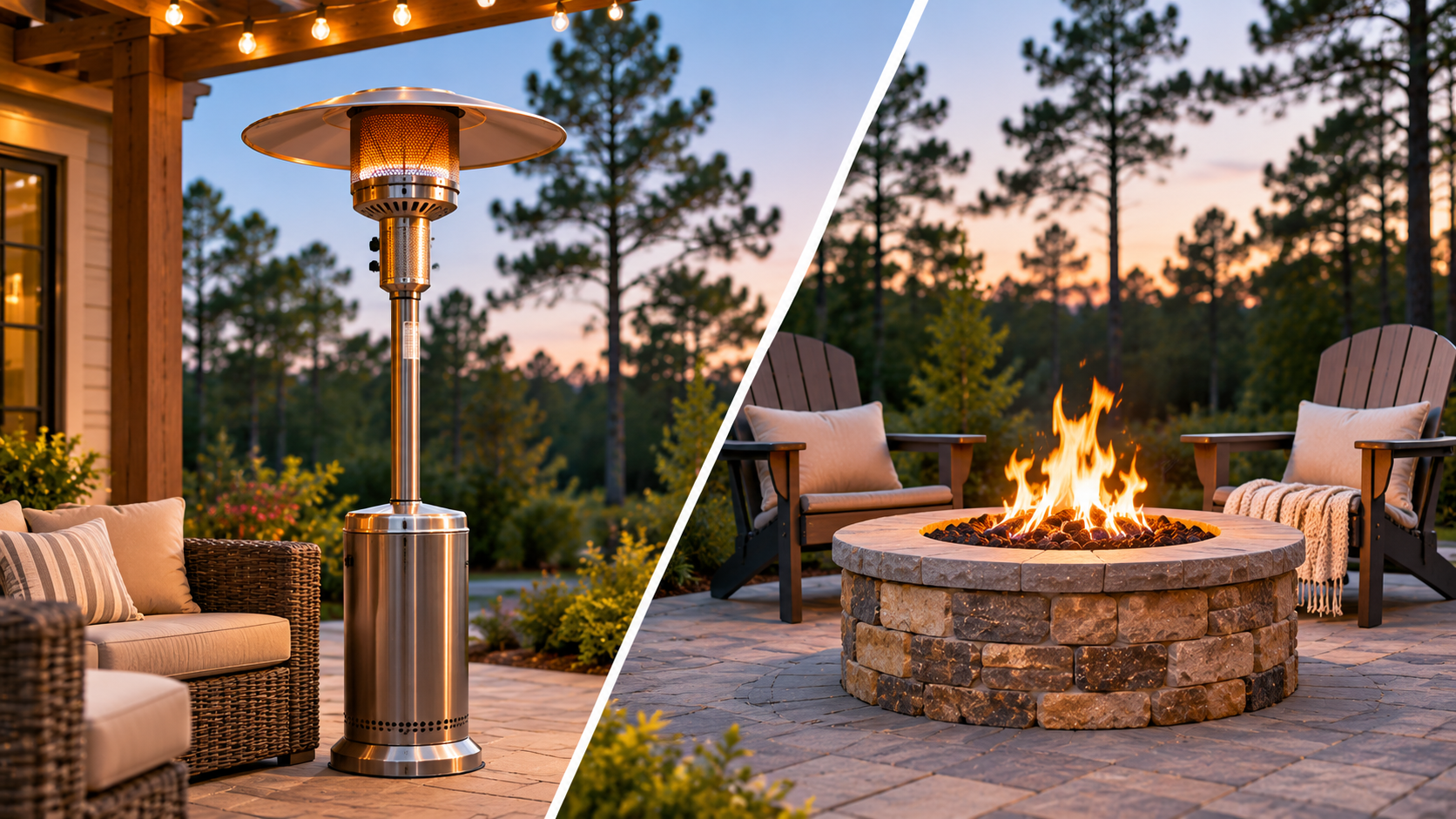
Patio heaters usually deliver stronger, more focused warmth with instant control and no smoke. Fire pits offer unmatched ambiance and a natural gathering point but heat mostly the side facing the flames. Heaters are often better for covered spaces, while fire pits shine on open patios designed for conversation.
| Factor | Patio Heater | Fire Pit |
| Warmth | Strong, focused heat | Warm in front, cooler behind |
| Heat direction | Downward or directional | Outward from the center |
| Ambiance | Functional | Cozy, social centerpiece |
| Wind performance | Radiant heat holds up fairly well | Flames and heat can blow around |
| Covered patio use | Some types are designed for it | Usually not suitable |
| Smoke and embers | None | Wood: yes; Gas: minimal |
| Startup and shutdown | Instant | Wood: slow; Gas: instant |
| Burn ban flexibility | Often more flexible, check orders | Wood fires often restricted |
| Maintenance | Low | Wood: ash cleanup; Gas: low |
| Social experience | Background warmth | Gathers people together |
The Bottom Line
If warmth is the top priority, a patio heater usually wins. If atmosphere and gathering matter most, a fire pit wins. For many Sandhills homes, the best answer is both.
Which Works Best for Your Patio Setup?
The best heat source depends on your patio layout. Covered patios and porches often suit electric or mounted heaters designed for those spaces. Open patios and golf course lots work well with fire pits plus wind protection. Large entertaining areas often benefit from multiple heaters and a central fire feature.
Covered Patios, Porches, and Pergolas
Covered spaces trap heat, which is great for comfort. But they need the right equipment.
Many electric infrared heaters are designed for mounting under covered patios. Gas heaters require proper clearance from ceilings and roofs. Always follow the manufacturer’s installation and clearance instructions.
Wood fire pits generally don’t belong under roofs or pergolas. Planning a new covered space? Our guide to pergola vs gazebo vs pavilion explains the differences.
Open Patios and Golf Course Lots
Open patios are perfect for fire pits. The circle of chairs, the dancing flames, and the open sky create that classic cozy night.
On windy golf course lots, add freestanding heaters behind seating areas to warm backs and shoulders.
Pool Decks and Large Entertaining Spaces
Large areas need multiple heat sources. A central fire feature plus a few freestanding heaters around the edges keeps everyone comfortable.
Small Patios and Cozy Corners
Tabletop heaters and compact fire tables work well in tight spaces. Choose models sized for your area, and keep proper clearance from walls and furniture.
Burn Bans and Local Rules to Keep in Mind
North Carolina burn bans can restrict wood-burning fire pits, especially during dry, windy periods. Gas fire features and patio heaters are often treated differently, but they aren’t automatically exempt. Local rules in Southern Pines and Pinehurst also set distance and size limits for fire pits. Always check current rules before lighting any fire.
Winter and early spring can bring dry, windy weather across North Carolina. That’s when burn bans are more likely.
Before using any fire feature:
- Check the NC Forest Service for statewide or county burn bans
- Check Moore County and your town for local bans
- Follow local distance and size rules for fire pits
- Call your local fire department if you’re unsure
Owning a gas fire feature or patio heater gives you more flexibility, but always read the specific ban order.
The Best of Both: How to Layer Heat for All-Winter Comfort
The most comfortable winter patios combine several elements: a fire feature for ambiance, patio heaters for focused warmth, wind protection like curtains or structures, and comfortable seating with cushions and throws. Layering these together turns a chilly patio into a cozy outdoor room you can use all winter.
Pair a Fire Feature With a Heater
Use a fire pit or fire table as the centerpiece. Then place a heater behind seating to warm backs and shoulders. Everyone stays warm from every side.
Browse our outdoor fire pits and Casual Comfort fire pits to find your centerpiece.
Block the Wind With Curtains and Structures
Wind steals heat fast. Blocking it makes any heat source work better.
EZShade canopies and curtains can help block breezes on pergolas and covered spaces. Adding a pergola or pavilion creates a sheltered outdoor room that holds warmth better.
Choose Seating That Holds Warmth
Deep, cushioned seating keeps you comfortable longer. Add outdoor throws and pillows for extra coziness.
Explore our deep seating collections for comfortable winter-ready seating.
Winter Heating Safety Tips
Use patio heaters and fire pits safely by following manufacturer clearance rules, keeping combustibles away, securing heaters against wind, using propane heaters only in well-ventilated outdoor spaces, storing fuel safely, and never leaving flames unattended. Checking for burn bans before lighting a fire adds another layer of safety.
- Follow clearance rules for ceilings, walls, and furniture
- Use propane heaters only outdoors in well-ventilated areas, never in enclosed spaces
- Secure freestanding heaters so wind can’t tip them over
- Keep pine straw, leaves, and cushions away from heat sources
- Store propane tanks upright and away from flames
- Never leave a fire or heater unattended
- Fully extinguish wood fires before going inside
- Keep a garden hose or fire extinguisher nearby
A little caution goes a long way toward many cozy, worry-free nights.
Ready to Warm Up Your Patio?
Choosing between a patio heater and a fire pit is easier when you can see and feel the options in person.
Visit GreyFox Outdoor at 225 W Morganton Rd, Suite C, in Southern Pines. Explore heaters, fire features, and cozy seating, or browse ideas in our fire pits gallery. Request a quote or call (910) 725-0394.
Frequently Asked Questions About Patio Heaters and Fire Pits
Which keeps you warmer, a patio heater or a fire pit?
Patio heaters usually keep you warmer because they deliver focused radiant heat from above or beside you. Fire pits warm the side of your body facing the flames, while your back may stay cool. For the best comfort, many homeowners use both together.
Can I use a patio heater under a covered patio or pergola?
Sometimes. Many electric infrared heaters are designed for mounting under covered patios. Gas heaters need proper clearance from ceilings and roofs. Always follow the manufacturer’s installation instructions, and never use propane heaters in enclosed spaces.
Is a propane or electric patio heater better?
It depends on your space. Propane heaters are portable and don’t need electrical outlets, making them great for open patios. Electric infrared heaters are often a strong choice for covered patios and porches with power access. Natural gas heaters suit permanent setups with a gas line.
Can I use a fire pit or patio heater during a burn ban?
Wood fire pits are often restricted during burn bans. Gas fire features and patio heaters are sometimes treated differently, but they aren’t automatically exempt. Always check the specific ban order from the NC Forest Service and your local fire department before use.
How cold is too cold to use a patio in the Sandhills?
With the right heat, wind protection, and cozy seating, many homeowners use their patios comfortably through most of the winter. January lows in Southern Pines average near 31°F, so very cold nights may still be better enjoyed indoors.
Should I get both a fire pit and a patio heater?
For many homes, yes. A fire pit creates ambiance and a gathering spot, while a patio heater adds focused warmth to backs and shoulders. Together, they make your patio comfortable on chilly evenings and help you use it more months of the year.
Enjoy Your Patio All Winter With GreyFox Outdoor
Linda and Mark added a gas fire table, a freestanding heater behind their sofa, and curtains on the windy side of their pergola.
Now, their patio stays busy all winter. Sunday afternoons with football on a tablet. Friday nights with friends around the fire. Quiet evenings wrapped in a throw blanket.
Your patio doesn’t have to hibernate. With the right heat and a little wind protection, a Sandhills winter can be one of the best seasons to enjoy the outdoors.
GreyFox Outdoor helps Moore County homeowners create outdoor spaces they can enjoy all year. Explore our patio furniture, learn about our outdoor living contractor services, or learn more about GreyFox Outdoor. Planning a visit? Read our guide on where to buy outdoor furniture in Southern Pines.
Call (910) 725-0394, contact our team, or find us on Google Maps. Let’s make your patio the coziest spot in the neighborhood this winter.