Table of Contents
- Why North Carolina’s Climate Changes Everything About This Decision
- Wait, What Is a Composite Playset Exactly?
- Wood vs. Composite: A Head-to-Head Comparison for NC Backyards
- The Hidden Rot Risk Inside Composite Playsets Nobody Talks About
- Where Wood Still Wins in North Carolina
- Where Composite Has the Edge
- The Third Option Most NC Parents Have Never Considered
- What to Look for When Buying a Playset in North Carolina
- Quick Comparison Table: Wood vs. Composite vs. Poly for NC Backyards
- The Verdict: Which One Actually Holds Up Best?
- FAQs About Playsets in North Carolina
- Build a Backyard Your Kids Won’t Want to Leave
You did the research. You picked the playset. You spent the weekend assembling it while the kids watched from the porch, barely able to contain themselves.
Two summers later, the boards are graying. There is a splinter situation developing on the lower deck. And you are quietly wondering if you picked the wrong material.
Sound familiar?
This is one of the most common frustrations among North Carolina parents who buy playsets without accounting for what the NC climate actually does to outdoor structures. Heat, humidity, pine pollen, and seasonal moisture cycling create a stress environment that separates the playsets that last from the ones that let you down.
This guide breaks down the wood vs. composite playset debate specifically for NC conditions, including a third option that most parents never hear about but probably should.
Why North Carolina’s Climate Changes Everything About This Decision
North Carolina’s combination of high summer humidity, intense UV exposure, and seasonal moisture swings creates one of the most demanding environments for outdoor wood structures in the entire country. Material choice matters more here than almost anywhere else.
The Humidity Problem in Moore County and Beyond
Summers in the Southern Pines and Moore County area regularly see humidity climb above 80 percent. That moisture does not just make afternoons uncomfortable. It works its way into wood fibers, promotes mold and mildew growth, and accelerates rot in any material that is not properly sealed or naturally resistant.
Wood is porous by nature. It absorbs moisture during wet periods and releases it during dry ones. That constant expansion and contraction is what causes warping, cracking, and eventual structural weakening.
Summer Heat, Pine Pollen, and What They Do to Outdoor Structures
Beyond humidity, NC summers bring intense heat and direct UV exposure that bleaches and dries wood surfaces quickly. Add in the pine pollen that coats everything from March through May, and you have a layer of organic debris sitting on your playset that traps moisture and feeds mold.
Any material you choose for a North Carolina backyard needs to handle all of this, not just one or two of these conditions.
Wait, What Is a Composite Playset Exactly?
Most parents use the word composite loosely, but it covers several different things. Getting clear on this before you buy is important.
The Difference Between True Composite and Vinyl-Wrapped Wood
A true composite playset uses decking and surface components made from a mixture of recycled wood fibers and plastic. The posts and structural beams, however, are almost always pressure-treated pine wrapped in a PVC vinyl sleeve.
This is not the same as a solid composite structure. The vinyl sleeve is a protective coating around a wood core, not a replacement for wood entirely.
Why the Label Matters More Than You Think
When a retailer calls something a composite or vinyl playset, they are usually describing the exterior finish, not the full material composition. The wood is still in there. How that wood holds up under the vinyl coating in a humid NC climate is a question worth asking before you hand over your card.
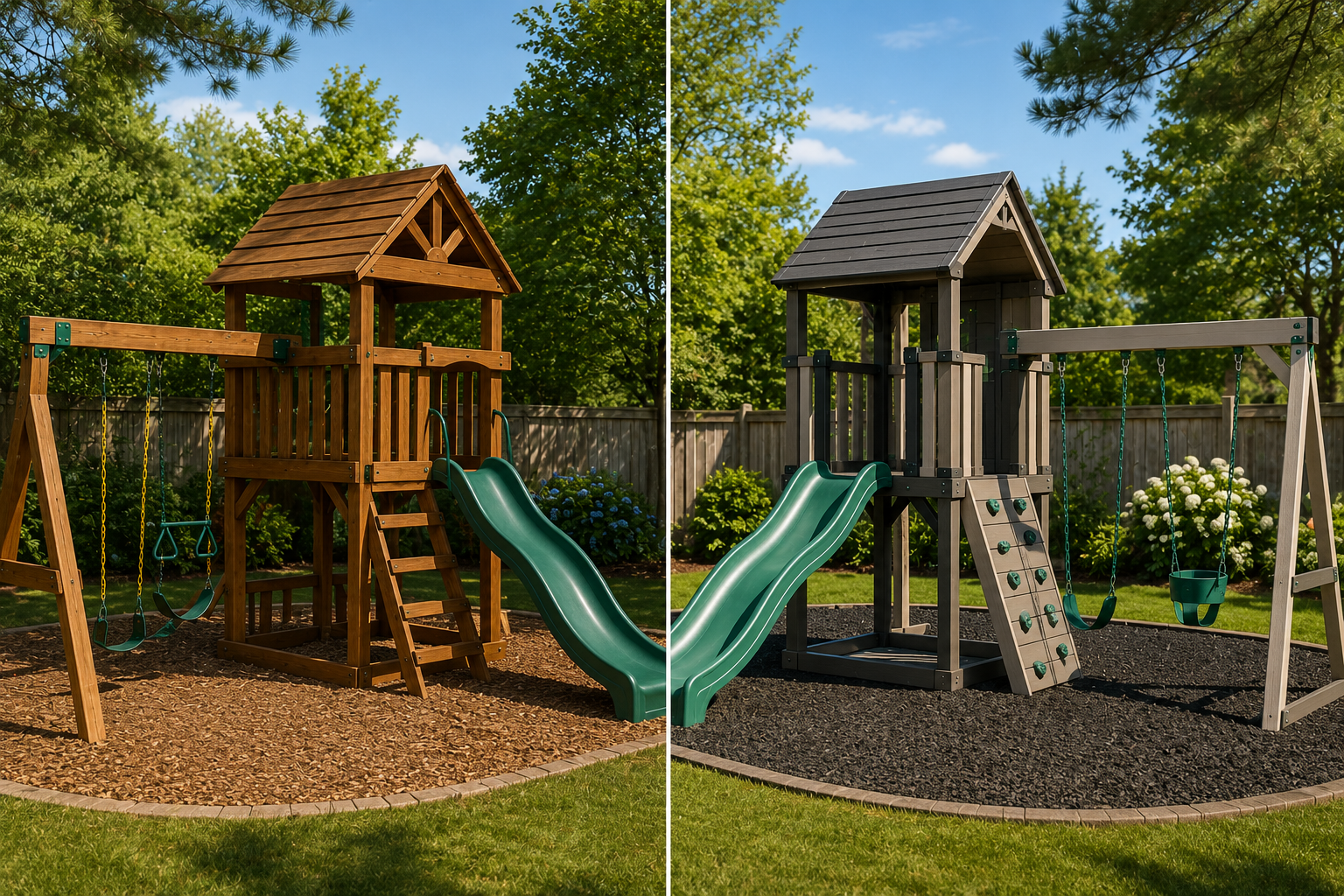
Wood vs. Composite: A Head-to-Head Comparison for NC Backyards
Let’s compare the two across the five factors that matter most to NC homeowners.
Humidity and Rot Resistance
Cedar and pressure-treated pine both handle NC humidity reasonably well when properly sealed. Cedar is naturally resistant to rot and insects due to its tannin content. Pressure-treated pine is chemically protected but still needs annual sealing to stay ahead of moisture.
Composite vinyl exteriors resist surface rot and eliminate splintering at the surface level. But the wood core inside the vinyl sleeve is a different story, which we will cover in detail shortly.
Edge: Cedar wood, when maintained properly.
Heat Tolerance in NC Summers
This is one area where composite and vinyl playsets have a real disadvantage that rarely gets mentioned. Dark vinyl surfaces absorb and retain heat. On a hot July afternoon in Southern Pines, a black or dark-colored vinyl playset can become uncomfortably hot, sometimes painfully so, for small hands and bare feet.
Natural wood surfaces stay cooler and more comfortable in direct sun.
Edge: Wood.
Maintenance Requirements Year Over Year
Wood playsets need annual cleaning, inspection, and re-staining or re-sealing. Cedar and pressure-treated pine both benefit from a fresh coat of water-repellent stain every one to two years. Skip this and you will start to see surface degradation within a season or two in NC conditions.
Composite vinyl exteriors need no staining or sealing. A hose rinse a couple of times a year is typically all the exterior needs.
Edge: Composite for low maintenance.
Lifespan in a Southern Climate
A well-maintained cedar playset in NC can last 15 to 20 years. Pressure-treated pine, with regular upkeep, runs 10 to 15 years. A composite vinyl playset can last 15 to 25 years on the exterior, but interior core degradation can shorten that significantly if moisture gets inside the vinyl sleeve.
Edge: Roughly even, with a major caveat for composite.
Cost Upfront vs. Cost Over Time
Wood playsets cost less upfront, typically $800 to $3,500 for quality residential sets in NC. Composite and vinyl sets run $2,500 to $6,000 or more. However, wood carries ongoing maintenance costs of $100 to $300 per year in materials and time.
Over a 15-year period, total cost of ownership often comes out similar or slightly lower for wood when you factor in maintenance expenses on both sides.
Edge: Wood for upfront cost. Composite for lower annual maintenance spend.
If you want a deeper look at full playset pricing in North Carolina, the 2026 NC backyard playset cost guide breaks down everything from installation to surfacing options.
The Hidden Rot Risk Inside Composite Playsets Nobody Talks About
This is the part most retailers skip over, and it is important.
How Moisture Gets Trapped Inside Vinyl Sleeves
Vinyl sleeves are excellent at keeping moisture out from the outside. The problem is what happens when moisture gets in from the inside, through ground contact, condensation, or small gaps at joints and connection points.
Once moisture is inside the vinyl sleeve, it has nowhere to go. The wood core cannot breathe, cannot dry out, and cannot be treated. The trapped moisture sits against untreated or minimally treated wood and begins the rot process from the inside.
What Happens When the Core Rots
Internal rot on a composite playset is essentially invisible until it becomes a structural problem. You cannot see it from the outside because the vinyl surface still looks clean. By the time you notice soft spots, instability, or visible damage, the structural integrity is already compromised.
Unlike a wood playset where a rotted board can be replaced at low cost, a rotted core inside a vinyl post typically means replacing the entire structural component or the whole set.
How to Spot It Before You Buy
Ask the manufacturer or retailer these direct questions before purchasing any vinyl-wrapped composite playset:
- What species of wood is used for the core posts?
- Is the wood pressure-treated before sleeving?
- How are the joints and connection points sealed against moisture intrusion?
- What is the warranty coverage specifically for structural rot?
A quality manufacturer will have clear, confident answers. Vague responses are a red flag.
Where Wood Still Wins in North Carolina
Cedar and Pressure-Treated Pine Done Right
Quality cedar remains one of the best playset materials for NC backyards. Its natural tannins resist rot and insects without chemical treatment. It is repairable, customizable, and stays cooler in summer heat. When properly sealed and maintained, it is a genuinely long-lasting investment.
Pressure-treated pine is a solid budget-friendly option if you commit to annual maintenance. The key in NC is never skipping the yearly re-seal, especially heading into fall when wet season begins.
The Repairability Advantage
This is a significant practical advantage that does not get enough attention. When a cedar board warps or a deck plank cracks on a wood playset, you replace that one board. Cost: $15 to $40 and a Saturday afternoon.
When the core of a vinyl-composite structural post fails, your options are far more limited and far more expensive.
Natural Feel and Customization
Wood playsets are easier to expand and modify as kids grow. Adding a climbing wall, rope bridge, or new swing beam to a wood structure is a straightforward DIY project. Composite sets are much less forgiving for modifications.
Where Composite Has the Edge
Low Maintenance for Busy Families
This is composite’s strongest selling point and it is a legitimate one. If the idea of annual staining and sealing genuinely will not happen in your household, a quality composite set with a solid warranty is a smarter choice than a wood playset that will go unmaintained and degrade faster as a result.
Honest self-assessment here matters more than which material is theoretically better.
Splinter-Free Surface for Young Kids
For families with toddlers and young children, the splinter-free exterior of a vinyl composite set is a real safety benefit. Even well-maintained cedar can develop surface roughness over time.
Consistent Appearance Over Time
Composite vinyl exteriors hold their color and appearance longer without intervention. If visual consistency matters to you and you prefer a clean, modern look over the natural weathered character of wood, composite delivers on that.
The Third Option Most NC Parents Have Never Considered
Here is where the conversation gets interesting.
What Is Poly Lumber and Why Does It Perform So Well in NC?
Poly lumber is made from high-density recycled polyethylene plastic. It does not rot, warp, splinter, crack, or absorb moisture. It requires no sealing, no staining, and no annual treatment whatsoever. And unlike dark vinyl surfaces, quality poly lumber in lighter colors stays comfortable to the touch even in direct NC summer sun.
It is the same material behind the most durable outdoor furniture on the NC market today.
How Poly Compares to Both Wood and Composite for Backyards
Poly lumber has no wood core to rot, no vinyl sleeve to trap moisture, and no annual maintenance requirement. In a high-humidity climate like Moore County, those three characteristics make it arguably the most climate-appropriate material available for long-term outdoor structures.
The tradeoff is higher upfront cost. But when you calculate cost per year of ownership over 20-plus years with zero maintenance spend, the math often works in poly’s favor.
To understand why poly lumber consistently outperforms other materials in the NC climate, the full breakdown in poly lumber vs. aluminum vs. teak for North Carolina is worth reading before you make any major outdoor investment.
Not Sure Which Material Is Right for Your NC Backyard?
The right answer depends on your budget, your maintenance habits, the age of your kids, and your specific yard conditions. If you are in the Southern Pines, Pinehurst, or Moore County area, GreyFox Outdoor can walk you through the options in person.
Visit us at 225 W Morganton Rd C, Southern Pines, NC 28387, call +1 910-725-0394, or find us on the map for a no-pressure conversation about what works best for your backyard.
What to Look for When Buying a Playset in North Carolina
Before you commit, run through this checklist with any playset you are seriously considering.
6 Things NC Buyers Should Check Before Committing:
- Wood species: Cedar or pressure-treated Southern Yellow Pine are the minimum standard for NC humidity. Avoid unlabeled generic wood.
- Hardware quality: Galvanized or stainless steel bolts and hardware only. Standard steel rusts quickly in humid NC conditions and weakens joints over time.
- Ground clearance: At least 9 inches of clearance beneath structural beams to prevent moisture pooling and accelerated rot at the base.
- Joint sealing on composite sets: Ask specifically how connection points are sealed. This is where moisture enters vinyl sleeve systems.
- Warranty specifics: Read what the structural warranty actually covers. Some exclude rot on the wood core inside vinyl components.
- Certification: Look for ASTM F1148 compliance, which is the standard for residential play equipment safety.
Quick Comparison Table: Wood vs. Composite vs. Poly for NC Backyards
| Factor | Cedar Wood | Composite/Vinyl | Poly Lumber |
| Humidity Resistance | Good with maintenance | Good exterior, risk at core | Excellent |
| Heat Tolerance | Excellent | Poor (dark surfaces) | Good |
| Maintenance Need | Annual | Minimal | None |
| Lifespan in NC | 15 to 20 years | 10 to 25 years (variable) | 25 to 50 years |
| Upfront Cost | Moderate | High | High |
| Repairability | Excellent | Limited | Moderate |
| Splinter Risk | Low with upkeep | None | None |
The Verdict: Which One Actually Holds Up Best in North Carolina?
For most NC families, quality cedar is the best balance of durability, repairability, and cost when maintained properly. Composite is a legitimate choice for families who genuinely will not maintain wood annually. Poly lumber is the highest-performing long-term option for NC’s climate but comes at a higher entry price.
There is no single universal winner. The right material depends on your specific situation. What is clear is that buying without factoring in NC’s climate is how families end up replacing playsets far sooner than they planned.
FAQs About Playsets in North Carolina
Does wood rot quickly in NC humidity?
Untreated or poorly maintained wood can show signs of rot within two to three NC seasons. Cedar and properly sealed pressure-treated pine hold up significantly better. Annual re-sealing in NC is not optional, it is the difference between a 5-year playset and a 20-year one.
Are composite playsets worth the extra cost in NC?
Composite playsets offer genuine low-maintenance benefits that are worth the premium for busy families. The caveat in humid NC climates is the risk of internal rot in vinyl-sleeved wood cores. Warranty coverage for structural rot is the key question to ask before buying.
What is the best wood for a playset in North Carolina?
Cedar is the best wood for NC playsets due to its natural rot and insect resistance. Pressure-treated Southern Yellow Pine is a solid budget alternative when sealed annually. Avoid unlabeled imported wood that may not be rated for humid Southern climates.
How often does a wood playset need maintenance in NC?
In North Carolina’s climate, wood playsets should be cleaned, inspected, and re-sealed or re-stained once per year. The best windows are late spring after pollen season ends and early fall before wet season begins.
Can composite playsets get too hot in NC summers?
Yes. Dark-colored vinyl and composite surfaces absorb significant heat in direct NC summer sun. On a hot afternoon, surface temperatures can reach levels that are uncomfortable or painful for young children. Natural wood and lighter-colored poly surfaces stay noticeably cooler.
Is poly lumber available for playsets in NC?
Poly lumber is widely used in NC for outdoor furniture and structures. Its application in playsets is growing as more families discover its climate performance advantages. GreyFox Outdoor carries poly lumber outdoor products and can help you explore options for your backyard.
Build a Backyard Your Kids Won’t Want to Leave
A playset is one of the best investments you can make in your backyard and in your kids’ childhood. The right material choice just makes sure that investment holds up through the NC summers, pollen seasons, and humidity cycles that will test it every year.
Whether you are leaning toward cedar, weighing composite, or curious about poly lumber, GreyFox Outdoor is Southern Pines’ destination for outdoor structures and furniture built specifically for the NC climate.
Explore our full range of outdoor structures and playset options, browse our polymer and aluminum collections built to handle NC weather year-round, or stop by our showroom at 225 W Morganton Rd C, Southern Pines, NC 28387.
Call us at +1 910-725-0394 or visit GreyFox Outdoor online to start planning a backyard your whole family will enjoy for years to come.