Table of Contents
- The Safety Gap Most NC Parents Do Not Know Exists
- Do Residential Backyard Playsets Have to Meet Safety Standards?
- What Are the ASTM F1148 and CPSC Guidelines?
- Fall Zone and Use Zone Requirements: How Much Space Does a Playset Actually Need?
- Safety Surfacing: What Should Go Under Your NC Backyard Playset?
- Age-Appropriate Design: Is Your Playset Right for Your Child’s Age?
- Common Playset Hazards Every NC Parent Should Inspect For
- Not Sure If Your Current Playset Meets Safety Standards?
- NC-Specific Safety Considerations Nobody Else Is Talking About
- Playset Installation Safety: Anchoring and Post Depth in NC
- How Often Should You Inspect Your Backyard Playset?
- What to Look for When Buying a Safe Playset in NC
- Frequently Asked Questions About Backyard Playset Safety in NC
- Build Something Your Kids Can Play on Safely for Years
The playset arrived on a Saturday morning. The kids were practically vibrating with excitement before it was even out of the box.
You spent the afternoon assembling it, following every instruction, tightening every bolt. By the time the sun started dropping behind the tree line, your children were already swinging and laughing and climbing like they had been waiting their whole lives for this moment.
And then, somewhere between putting away the tools and pouring yourself a drink, a quiet thought crept in.
Is it actually safe?
Not just put-together-correctly safe. But genuinely, structurally, is standard-meeting safe for the soil in your backyard, the NC summer heat, and the specific ages and weights of your kids?
If you have never asked that question, you are not alone. Most parents assume playsets sold in retail stores are automatically safe. Some are. Some are not. And the difference matters more than most people realize.
This guide answers every question a NC parent should be asking about backyard playset safety standards, in plain language, with practical information you can actually use.
The Safety Gap Most NC Parents Do Not Know Exists
Why Assuming a Playset Is Safe Can Be a Costly Mistake
The Consumer Product Safety Commission estimates that emergency rooms treat over 200,000 playground-related injuries in the United States every year. A significant portion of those happen on residential backyard equipment, not commercial playgrounds.
The reason is not that residential playsets are inherently more dangerous. It is that most parents do not know what safety standards exist for home use, what they actually require, and whether the playset they bought meets them.
What No One Tells You When the Playset Box Arrives
No retailer includes a safety standards compliance certificate with a residential playset purchase. No instruction manual explains what fall zone your yard needs to accommodate the equipment safely. No one mentions how deep the posts need to be set in NC red clay soil or what happens to untreated wood after three summers of Sandhills humidity.
That information gap is what this guide fills.
Do Residential Backyard Playsets Have to Meet Safety Standards?
Residential backyard playsets are not legally required to meet the same mandatory safety standards as commercial playground equipment. However, the ASTM F1148 standard and CPSC guidelines for home playground equipment provide the most widely referenced safety framework for residential playsets and are used by reputable manufacturers as a design and construction benchmark.
Residential vs Commercial Playground Standards: What Is the Difference?
Commercial playgrounds in public parks and schools must comply with ASTM F1292 and ASTM F1487 standards, which are enforced through local building codes and liability requirements. These are mandatory.
Residential playsets fall under ASTM F1148, which is a voluntary standard. Voluntary does not mean optional for parents who care about safety. It means the government does not require manufacturers to follow it. Reputable manufacturers follow it anyway because it represents the best available safety research for home playground equipment.
Why Voluntary Standards Still Matter for Your Family
A playset built to ASTM F1148 specifications has been designed with tested fall height ratings, hardware specifications, structural load requirements, and entrapment prevention guidelines. A playset that ignores these standards has not.
When you are comparing playset options for your NC backyard, asking whether a manufacturer designs ASTM F1148 is one of the most important questions you can ask.
What Are the ASTM F1148 and CPSC Guidelines? (Plain Language Explanation)
What ASTM F1148 Actually Covers
ASTM F1148 is the Standard Consumer Safety Performance Specification for Home Playground Equipment. It covers structural integrity requirements, hardware specifications, entrapment opening limits, protrusion hazard limits, and surfacing recommendations for residential playsets.
In practical terms, it defines things like:
- The maximum size of openings where a child’s head could become trapped
- The minimum thickness and type of hardware allowed
- The load requirements structural components must withstand
- Swing clearance minimums from the ground and from other structures
- Slide angle and exit velocity considerations
What the CPSC Public Playground Safety Handbook Says for Home Use
The CPSC publishes a handbook that, while primarily focused on public playgrounds, contains widely adopted guidance for residential equipment as well. It covers fall zones, surfacing depth requirements, age-appropriate equipment selection, and inspection protocols.
The CPSC recommends that all home playground equipment be installed over impact-attenuating surfacing and maintained with regular inspection schedules. These recommendations are the foundation of every safety decision covered in this guide.
How These Standards Protect Your Child in Practice
Standards are not abstract. They translate directly into real measurements and real decisions. The fall zone size around your playset, the depth of mulch underneath it, the height of the platform your child stands on, and the size of every opening their body could fit through are all governed by these guidelines.
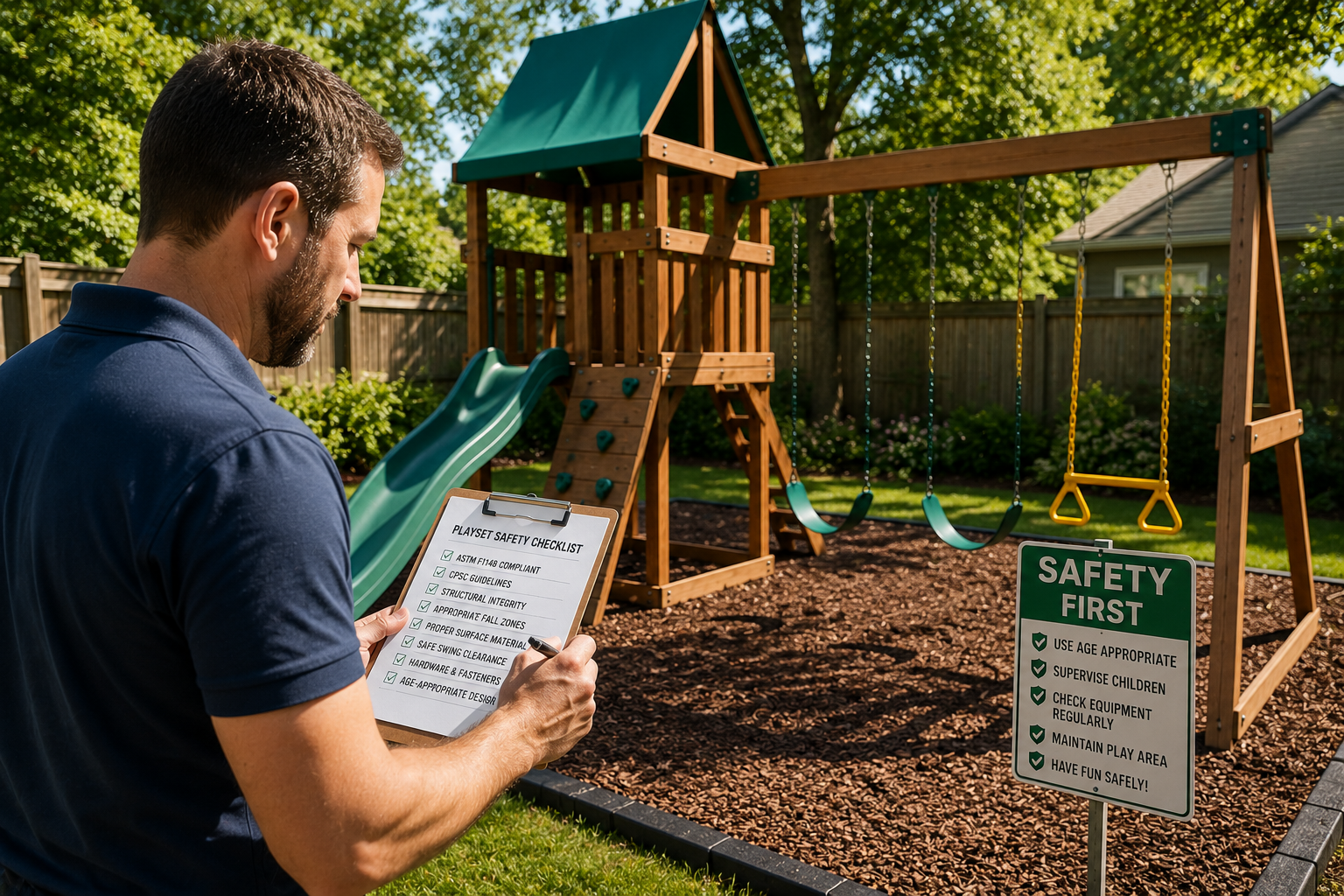
Understanding them gives you a checklist you can apply to any playset before you buy it or before you let your children use it.
Fall Zone and Use Zone Requirements: How Much Space Does a Playset Actually Need?
The CPSC recommends a fall zone of at least 6 feet in every direction around the perimeter of any residential playset. For swings, the fall zone must extend in front of and behind the swing a distance equal to twice the height of the pivot point from the ground. This use zone must be covered entirely with appropriate safety surfacing.
What Is a Fall Zone and Why Does It Matter?
The fall zone is the area of ground surrounding a playset that must be covered with impact-attenuating surfacing to cushion a child’s fall. It is not just the area directly under the equipment. It extends outward from every edge where a child could fall or jump.
A child who falls from a platform does not fall straight down. They fall outward. A child jumping from a swing travels several feet beyond the swing arc. The fall zone accounts for all of this.
Minimum Fall Zone Dimensions Every NC Parent Should Know
For most residential playsets:
- At least 6 feet of safety surfacing in every direction from the outer edges of the equipment
- For swings: a distance in front of and behind the swing equal to twice the height of the top bar (so a swing with a 7-foot top bar needs at least 14 feet of fall zone in front and behind)
- No obstacles including fences, trees, or other equipment within the fall zone
What Happens When the Fall Zone Is Too Small?
A fall zone that stops at the fence line, the garden bed, or the concrete patio edge is not a fall zone. It is a false sense of security. A child who falls or jumps and lands outside the safety surfacing area lands on whatever surface exists there, with no impact protection.
Many NC backyard playset injuries happen not because the equipment failed but because the fall zone was undersized for the space it was placed in.
Safety Surfacing: What Should Go Under Your NC Backyard Playset?
Why the Ground Surface Is the Most Important Safety Decision You Make
The surface under a backyard playset is its most critical safety feature. Impact-attenuating materials including engineered wood fiber, wood chips, rubber mulch, sand, and pea gravel all provide fall protection when installed at the correct depth. Grass, dirt, and compacted surfaces do not provide adequate impact protection and should never be used as the sole surfacing under a playset.
Surfacing Options Compared
Engineered Wood Fiber is the top-rated surfacing option for residential playsets. It compacts less than natural wood chips, maintains impact attenuation longer, and drains well through NC rain seasons. It is the material most closely aligned with ASTM F1292 impact testing recommendations.
Wood Chips and Mulch are widely used and effective when maintained at adequate depth. NC’s humidity can accelerate decomposition, so depth maintenance is more important here than in drier climates. Check and replenish twice per year.
Rubber Mulch provides excellent long-term impact protection, does not decompose, and maintains consistent depth with minimal maintenance. It costs more upfront but requires less ongoing attention, making it a practical choice for NC families who want a low-maintenance safety surface.
Sand and Pea Gravel both provide adequate impact protection at the correct depth but compact over time and can migrate out of the fall zone. They require regular raking and replenishment. Sand also retains moisture in NC’s humid climate, which can create hygiene concerns.
How Deep Does Safety Surfacing Need to Be?
| Surfacing Material | Minimum Depth for Falls Up to 7 Feet | Minimum Depth for Falls Up to 10 Feet |
| Engineered Wood Fiber | 9 inches | 12 inches |
| Wood Chips | 9 inches | 12 inches |
| Rubber Mulch | 6 inches | 9 inches |
| Sand | 9 inches | 12 inches |
| Pea Gravel | 9 inches | 12 inches |
These depths apply when the material is uncompacted. Check depth regularly and replenish before it drops below the minimum.
What Surfaces You Should Never Use Under a Playset
Concrete, asphalt, packed dirt, grass, and decorative stone are never appropriate as the primary surfacing under a residential playset regardless of how close the equipment is to the ground. These surfaces provide no meaningful impact attenuation and significantly increase injury severity in falls.
Age-Appropriate Design: Is Your Playset Right for Your Child’s Age?
Playset Features Recommended for Ages 2 to 5
Toddler and preschool-age children need lower platform heights, enclosed slides with lower angles, bucket swings with full back support, and wider spacing between rungs and steps. Maximum platform height for this age group should not exceed 4 feet. Openings should be sized to prevent head entrapment for smaller head sizes specific to this age range.
Playset Features Recommended for Ages 5 to 12
School-age children can safely use platform heights up to 8 feet, standard belt swings, steeper slides, monkey bars, and rock climbing walls. Hardware and structural load ratings must be appropriate for the higher weight ranges in this age group.
Why Using the Wrong Age-Range Equipment Creates Hidden Risks
A toddler using school-age equipment faces openings too large for their smaller head, platform heights too great for their coordination level, and swing heights inappropriate for their size. A school-age child on toddler equipment may exceed the weight rating on components designed for lighter loads. Both create real injury risk that age-appropriate design prevents.
Common Playset Hazards Every NC Parent Should Inspect For
Entrapment and Head Entrapment Hazards
Openings between 3.5 inches and 9 inches are considered entrapment hazards for children’s heads and necks. Any opening in your playset within this range on platforms, railings, or between components should be addressed immediately. Check every gap, space, and opening with a measuring tape, not just a visual estimate.
Protrusion and Sharp Edge Hazards
Hardware including bolts, screws, and S-hooks should be recessed or capped so no protrusion extends more than a fraction of an inch beyond the surface. Check all hardware after seasonal temperature changes in NC because expansion and contraction can cause bolts to work loose or shift over time.
Entanglement Hazards: Ropes, Cords, and Clothing Risks
Ropes attached to the playset should either be taut between two points or have no free ends. Loose rope ends, drawstrings, and jump ropes left on the equipment create strangulation risks. Remove any rope accessories when children are not directly supervised.
Hardware and Structural Integrity Checks
Check all connection points for rust, cracking, splitting, or movement that was not there at installation. In NC’s humid climate, hardware corrosion and wood degradation happen faster than in drier regions. Any component that flexes, wobbles, or shows visible deterioration needs attention before the playset is used again.
Not Sure If Your Current Playset Meets Safety Standards?
If you are looking at your backyard playset right now and realizing you have never formally checked it against any safety standard, you are in the same position as most NC families.
GreyFox Outdoor carries playset options designed with ASTM F1148 compliance in mind and built for the specific demands of NC’s climate and soil conditions. Whether you are buying new or want guidance on what to look for in your current setup, our team at 225 W Morganton Rd C, Southern Pines, NC is here to help.
Call us at +1 910-725-0394 or explore our outdoor structures and playset options to see what safety-focused outdoor play equipment looks like in practice.
NC-Specific Safety Considerations Nobody Else Is Talking About
How NC Humidity and Heat Affect Wood Playset Safety Over Time
Untreated or under-treated wood in the NC Sandhills and Piedmont regions faces a challenging environment. Summer humidity regularly exceeds 80 percent. Afternoon heat drives moisture into wood fibers and accelerates the expansion and contraction cycle that leads to splitting, cracking, and fastener loosening.
A wood playset that looks structurally sound in April can develop significant hardware loosening and surface cracking by September if it is not built from properly treated lumber. Inspect wood playsets at the beginning and end of each summer season at minimum.
Red Clay Soil and What It Means for Post Anchoring Stability
NC red clay soil is dense when dry and expands significantly when wet. This expansion and contraction cycle affects post anchoring stability differently than the sandy or loam soils found in other regions. Posts set without concrete footings in red clay are at higher risk of shifting seasonally, which affects the structural alignment of the entire playset over time.
Why Composite Playsets Hold Up Differently Than Wood in NC Summers
Composite and polymer materials do not absorb moisture the way wood does. They do not split, crack, or develop the mold and mildew surface growth that untreated wood faces in NC’s climate. For families in the Fayetteville, Southern Pines, and Pinehurst areas, composite playset components often represent a more structurally consistent choice over a 10 to 15 year lifespan compared to wood alternatives.
If you are weighing material options for your NC backyard, the detailed breakdown in the backyard playset cost guide for NC families covers how material choice affects both upfront cost and long-term maintenance.
Playset Installation Safety: Anchoring and Post Depth in NC
How Deep Should Playset Posts Be Set in NC Soil?
For most residential playsets in NC, posts should be set a minimum of 18 to 24 inches deep. In red clay soil areas, deeper is better because of the seasonal expansion and contraction cycle. Posts set at 24 inches with concrete footings provide significantly more long-term stability than surface-mounted anchor systems for full-size playsets.
Concrete Footings vs Ground Anchor Systems: Which Is Safer?
Concrete footings provide superior long-term stability for larger playsets with climbing structures, swings, and platforms. Ground anchor systems, which use screw-in or stake-style anchors, are appropriate for smaller lightweight playsets but should not be used as the sole anchoring method for full-size multi-component equipment in NC’s variable soil conditions.
Why Level Ground Matters More Than Most Parents Realize
A playset installed on ground that slopes even a few degrees creates uneven load distribution across all structural components. Over time, this accelerates hardware loosening, platform warping, and post movement. If your installation site is not level, address the grade before installation, not after.
How Often Should You Inspect Your Backyard Playset?
The CPSC recommends inspecting residential playsets at least three times per year: once in spring before the primary play season begins, once mid-summer, and once in fall before winter weather arrives. Additional checks should follow any significant storm, heavy use period, or after children report something feels loose or different.
The Seasonal Inspection Checklist for NC Homeowners
Spring inspection: Check all hardware for winter corrosion and loosening. Inspect wood surfaces for cracking or splitting. Replenish safety surfacing to correct depth. Check fall zone for root growth, debris, or encroachment.
Summer mid-season check: Inspect hardware again after heat expansion. Check surface for hot spots on metal components that could cause burns. Verify rope and swing components are intact and correctly attached.
Fall inspection: Check for end-of-season structural wear. Address any wood rot or corrosion before winter moisture accelerates it. Clear debris from fall zone and replenish surfacing.
Signs Your Playset Needs Immediate Attention
- Any structural component that wobbles, flexes, or moves independently
- Visible rust on hardware especially at connection points
- Wood cracking or splitting at post bases or platform supports
- Openings that have widened due to material movement
- Missing or damaged hardware caps or end covers
When It Is Time to Replace Rather Than Repair
A playset more than 10 to 12 years old with significant wood deterioration, corroded hardware throughout, or structural components that have shifted out of alignment warrants replacement rather than ongoing repair. The cumulative cost of addressing multiple aging components often approaches or exceeds the cost of a new installation, and the safety outcome of a new quality playset is considerably more reliable.
What to Look for When Buying a Safe Playset in NC
Questions to Ask Before You Buy
Before purchasing any backyard playset for your NC home, ask these questions directly:
- Is this playset designed to ASTM F1148 specifications?
- What wood treatment or composite material is used and how does it perform in high-humidity climates?
- What is the weight rating for each component?
- What anchoring method is recommended and what post depth is required?
- What safety surfacing does the manufacturer recommend for this equipment’s fall height?
What Separates a Safety-Conscious Playset Brand From the Rest
Brands that take safety seriously publish their compliance specifications, use hardware rated for outdoor exposure, design with fall zone requirements in mind, and provide clear documentation about age ranges and weight limits. Brands that do not answer basic safety questions directly are telling you something important about their priorities.
GreyFox Outdoor carries outdoor play structures selected for both NC climate durability and safety-forward design. Browse our outdoor structures collection or visit us in Southern Pines to see the options in person.
For NC families thinking about the full backyard picture beyond the playset, our guides on pergola and outdoor structure options for NC communities and outdoor furniture that lasts in North Carolina’s climate cover everything you need to build an outdoor space your whole family can enjoy safely for years.
Frequently Asked Questions About Backyard Playset Safety in NC
What safety standards should a backyard playset meet in NC?
Residential backyard playsets should be designed to ASTM F1148 standards and installed following CPSC home playground safety guidelines. While these standards are voluntary for residential equipment, they represent the best available safety research and are followed by reputable playset manufacturers. Look for explicit ASTM F1148 compliance when comparing playset options.
How far should a playset be from a fence in NC?
The CPSC recommends a minimum 6-foot fall zone in every direction from the outer edges of any residential playset. This means the nearest fence, wall, tree, or obstacle should be at least 6 feet from the outermost edge of the equipment. For swings, the required clearance is greater and based on the height of the top bar.
What is the safest surface to put under a backyard playset?
Engineered wood fiber is widely considered the top-rated safety surfacing for residential playsets due to its consistent impact attenuation and drainage performance. Wood chips, rubber mulch, sand, and pea gravel are also acceptable options when installed at the correct depth. Grass, dirt, and hard surfaces should never be used as the primary surfacing under a playset.
How deep should safety surfacing be under a playset?
Depth requirements depend on the material and the fall height of the equipment. For falls up to 7 feet, most loose-fill materials require a minimum of 9 inches of uncompacted depth. Rubber mulch can provide adequate protection at 6 inches for the same fall height. Check and replenish depth regularly as materials compact and migrate over time.
Does NC climate affect playset safety?
Yes significantly. NC’s high summer humidity accelerates wood rot, hardware corrosion, and the expansion-contraction cycle that loosens fasteners over time. Red clay soil affects post anchoring stability differently than other soil types. NC families should inspect playsets more frequently than the national minimum recommendation and consider composite or polymer components for better long-term performance in the local climate.
How often should I inspect my backyard playset?
The CPSC recommends at least three formal inspections per year: spring, mid-summer, and fall. In NC’s climate, additional checks after summer storms and at the beginning and end of the high-humidity season are strongly advisable. Any report from a child that something feels loose or different should trigger an immediate inspection before further use.
At what age can children use full-size playset equipment?
Full-size playset features including platforms up to 8 feet, standard belt swings, and climbing structures are generally appropriate for children ages 5 to 12. Children ages 2 to 5 should use equipment specifically designed for their age range with lower platform heights, enclosed slides, and bucket swings. Always verify the manufacturer’s stated age and weight ratings for specific components.
Build Something Your Kids Can Play on Safely for Years
Every parent wants the same thing from a backyard playset. Not just fun, but safe fun. The kind where you can watch from the back porch without that quiet worry in the back of your mind.
Getting there is not complicated. It is about buying equipment designed to real standards, installing it correctly for NC soil conditions, surfacing it properly, and inspecting it regularly. None of these steps are difficult once you know what you are looking for.
GreyFox Outdoor helps NC families in Southern Pines, Pinehurst, Fayetteville, and the surrounding area make outdoor living decisions they feel confident about. Our playset and outdoor structure options are selected with NC’s specific climate, soil, and lifestyle in mind.
Visit us at 225 W Morganton Rd C, Southern Pines, NC 28387, call us at +1 910-725-0394, or browse our full outdoor structures collection to find playset options built for families who take both fun and safety seriously.
Your kids deserve a backyard they can grow up in. Let us help you build it right.