Table of Contents
- Why Most Commercial Outdoor Furniture Fails NC Restaurants and Hotels
- Commercial vs Residential Outdoor Furniture: Why the Distinction Matters
- Materials That Perform Best in NC’s Climate for Hospitality Use
- What to Look for Beyond Material: Commercial Construction Quality Markers
- ADA and Commercial Compliance Considerations for NC Outdoor Dining
- Style and Brand Consistency for NC Hospitality Properties
- Total Cost of Ownership: The Comparison NC Operators Need to Make
- Volume Purchasing and Procurement Timeline for NC Hospitality
- Ready to Select Commercial Outdoor Furniture for Your NC Property?
- Frequently Asked Questions About Commercial Outdoor Furniture for NC Restaurants and Hotels
- Visit GreyFox Outdoor for Your NC Hospitality Furniture Consultation
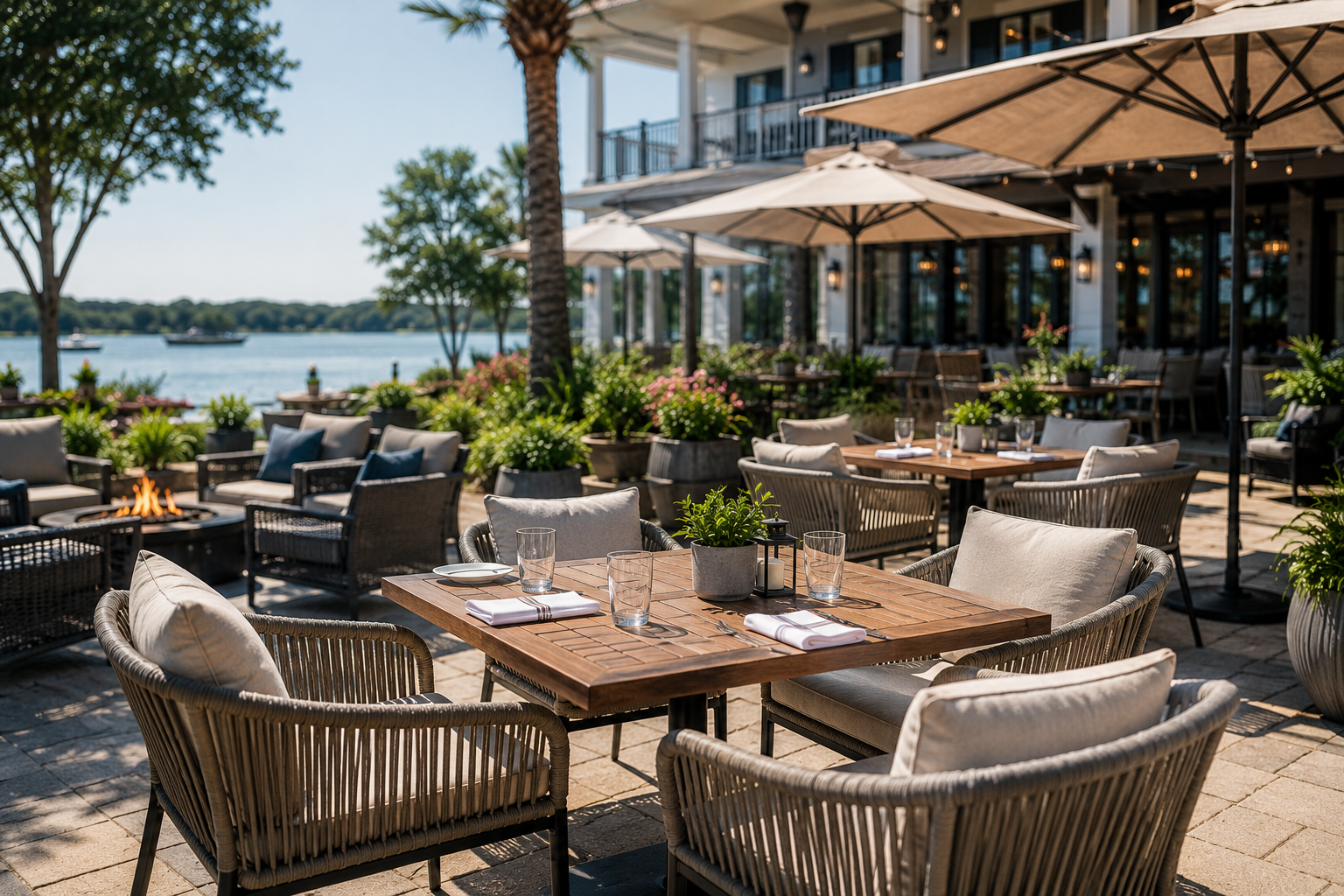
The patio renovation is planned. The budget is approved. You are ready to outfit your restaurant or hotel outdoor area with furniture that will hold up to daily guest use, NC’s summer heat and humidity, and the test of time.
Then you start looking at options and realize that most guides are written for homeowners, not for hospitality operators making procurement decisions for commercial environments.
A homeowner and a restaurant operator have fundamentally different needs. A homeowner needs furniture that lasts five to seven years with light family use. A restaurant or hotel operator needs furniture that withstands multiple daily guest seating cycles, commercial cleaning products, UV exposure in the NC Sandhills, and the specific combination of heat and humidity that breaks down lower-quality materials faster than any other climate factor.
This guide is written for the hospitality procurement decision. Materials, construction quality, ADA compliance, total cost of ownership, and procurement timeline, all calibrated for NC’s climate and commercial use requirements.
For a consultation on commercial outdoor furniture for your NC property, GreyFox Outdoor serves NC restaurants, hotels, and hospitality operators from our Southern Pines showroom.
Why Most Commercial Outdoor Furniture Fails NC Restaurants and Hotels
The NC Climate Factors That Accelerate Furniture Deterioration
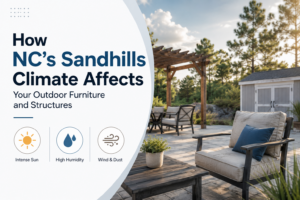
North Carolina’s Sandhills and coastal plain regions combine high summer temperatures, significant humidity, intense UV exposure, and seasonal rainfall in a way that is particularly hard on outdoor furniture materials. The UV index in Moore County during summer months reaches levels that bleach and degrade lower-quality materials within two to three seasons. The humidity that follows NC’s summer heat penetrates porous materials, accelerates rust in low-grade hardware, and promotes mold growth in cushions and wicker construction.
What works in a dryer climate fails faster in NC. What performs adequately in a residential setting fails significantly faster under commercial hospitality use in NC’s specific climate.
The Three Most Common Commercial Furniture Mistakes NC Hospitality Operators Make
Buying residential-grade furniture for commercial settings. The price looks right and the furniture looks similar. After 18 months of multiple daily seating cycles, cleaning, and NC climate exposure, the difference in construction quality is visible and expensive.
Prioritizing aesthetic over material performance. A furniture set that looks excellent in a showroom but uses inferior materials for NC’s climate will look aged and worn before it has generated enough guest experiences to justify its replacement cost.
Choosing based on upfront price rather than total cost of ownership. The $150 per chair option that requires replacement every three years costs significantly more over ten years than the $400 per chair option that lasts fifteen years with minimal maintenance.
Commercial vs Residential Outdoor Furniture: Why the Distinction Matters
Commercial-grade outdoor furniture is engineered for high-frequency use by multiple users across extended daily periods, using heavier gauge materials, commercial-grade hardware, reinforced frame connections, and construction standards that meet or exceed industry durability benchmarks. Residential furniture is designed for light family use. The difference becomes visible within 18 to 24 months of commercial use.
What Makes Furniture Commercially Rated
Commercial rating is not a marketing claim. It is a construction specification. Commercial-grade outdoor furniture uses heavier aluminum extrusions (typically 1.5 to 2mm wall thickness versus residential’s 1 to 1.2mm), stainless or marine-grade hardware at all connection points, frame connections that are welded and reinforced rather than bolted at single points, and finish applications that withstand commercial cleaning products rather than just weather.
Weight ratings on commercial furniture reflect the engineering required to support multiple users of varying sizes across thousands of use cycles. Residential furniture’s weight ratings assume typical family use patterns, not commercial hospitality loading.
The Specific Differences That Show Up After 18 Months of Commercial Use
Residential furniture in a commercial setting shows its limitations at specific points: frame wobble at hardware connections from frequent use, fading or chalking from commercial cleaning products not compatible with residential finishes, rust bleeding from standard hardware at welded joints, and webbing or wicker breakdown from the combination of UV exposure and commercial cleaning frequency.
These are not random failures. They are predictable outcomes of using a product in a way it was not engineered to perform.
Why Residential Furniture in a Commercial Setting Creates More Problems Than It Solves
Beyond the replacement cost cycle, residential furniture in commercial hospitality settings creates guest experience problems before it creates budget problems. Wobbling chairs, faded finishes, and visibly deteriorated furniture communicate something to guests about the property’s standards that no other investment can fully compensate for. The furniture your guests sit in is part of your brand presentation.
Materials That Perform Best in NC’s Climate for Hospitality Use
For NC restaurants and hotels, poly lumber (HDPE) is the top-performing low-maintenance material for NC’s humidity and UV exposure. Aluminum provides excellent durability at lower weight for high-traffic NC hospitality applications. All-weather wicker on aluminum frames delivers aesthetic appeal with adequate commercial durability. Teak provides premium performance at premium cost. All four outperform wrought iron, standard steel, and wood frame options in NC’s commercial hospitality climate.
Poly Lumber: The Maintenance-Free Option for NC Humidity
Poly lumber (high-density polyethylene) is manufactured from recycled plastics and performs exceptionally well in NC’s combination of humidity, UV exposure, and heat. It does not absorb moisture, does not rot, does not require sealing or staining, and holds its color under NC’s intense summer UV without fading or chalking.
For NC restaurant and hotel operators who want to eliminate maintenance costs from their outdoor furniture budget, poly lumber is the closest thing to a truly maintenance-free commercial option available. It is also the heaviest material option, which reduces wind displacement in NC’s coastal plain and Sandhills wind patterns.
Aluminum: Lightweight Durability for High-Traffic NC Hospitality
Commercial-grade aluminum is the most versatile material for NC hospitality applications because it combines genuine durability with light weight and broad aesthetic flexibility. It does not rust, handles NC’s humidity without degradation, and tolerates commercial cleaning products well when properly powder-coated.
The key distinction for NC hospitality buyers is aluminum gauge. Commercial-grade aluminum furniture uses heavier extrusions than residential product. The difference in rigidity and long-term structural integrity between 1.2mm and 2mm wall thickness is significant after several years of commercial use.
For a complete analysis of how aluminum compares to other outdoor furniture materials specifically for NC’s climate, our guide on poly lumber vs aluminum vs teak for NC outdoor furniture provides the detailed material comparison.
All-Weather Wicker on Aluminum Frames: The Aesthetic Performer
All-weather synthetic wicker on commercial aluminum frames delivers the warm, inviting aesthetic that many NC restaurants and resort hotels want for their outdoor dining areas. The distinction from residential wicker is the frame: commercial all-weather wicker uses aluminum frames throughout, not steel or wood frames that will deteriorate in NC’s humidity.
The wicker weave itself should be UV-stabilized PE resin rated for direct sun exposure. Lesser materials become brittle and crack under NC’s summer UV within two to three seasons.
Teak: Premium Performance at a Premium Price
Teak is the highest-performing natural wood for NC hospitality applications because its natural oils make it resistant to moisture, insects, and rot without treatment. Properly maintained teak furniture lasts decades and develops a silver-grey patina that many NC resort and hotel operators find aesthetically appropriate for their property.
The trade is cost and maintenance. Teak costs significantly more than aluminum or poly lumber at purchase and requires annual oiling to maintain its original warm color. For NC hospitality operators who want the aesthetic and are willing to maintain it, teak is the premium choice.
Materials to Avoid for NC Commercial Hospitality Applications
Standard steel frames rust in NC’s humidity regardless of paint coating quality. Wood frames other than teak (pine, eucalyptus, acacia) absorb moisture and deteriorate faster than NC’s climate allows for commercial replacement cycles. Standard wicker without aluminum frames fails quickly. Cheap powder-coated aluminum with thin walls develops stress fractures at high-use connection points.
Material Performance Comparison Table for NC Hospitality
| Material | NC Humidity Performance | UV Resistance | Maintenance Required | Commercial Durability | Relative Cost |
| Poly Lumber | Excellent | Excellent | Minimal | High | Mid-high |
| Aluminum (commercial) | Excellent | Excellent | Low | High | Mid |
| All-weather wicker/aluminum | Good | Good | Low | Moderate-high | Mid |
| Teak | Excellent | Good | Moderate | High | High |
| Standard steel | Poor | Moderate | High | Low | Low |
| Residential aluminum | Moderate | Moderate | Moderate | Low | Low-mid |
What to Look for Beyond Material: Commercial Construction Quality Markers
Beyond material choice, NC hospitality operators should evaluate frame wall thickness (commercial minimum 1.5mm aluminum), hardware specification (stainless steel or marine-grade at all connection points), weld quality (full welds not spot welds at structural joints), weight ratings (minimum 300 lbs for commercial seating), and stackability design for storage efficiency.
Frame Thickness and Weld Quality
Ask for the wall thickness specification on any aluminum furniture you are evaluating for commercial NC hospitality use. The difference between 1.2mm residential and 2mm commercial is significant for long-term structural integrity under daily commercial loading.
Examine or ask about weld quality at critical structural joints. Full continuous welds at seat-to-leg and back-to-seat connections withstand repetitive loading far better than spot welds or bolt connections at these points.
Hardware Specifications for NC’s Humid Environment
Every hardware connection point on outdoor hospitality furniture in NC should be stainless steel or marine-grade aluminum. Standard zinc or plated steel hardware rusts at connection points within two to three NC seasons, creating visible rust bleeding and structural loosening.
This is one of the most common quality differences between furniture that holds up in NC’s commercial hospitality environment and furniture that does not.
Stackability and Storage Design for Commercial Operations
NC restaurants and hotels need to move and store outdoor furniture regularly for cleaning, weather events, and seasonal adjustments. Commercial outdoor furniture designed for hospitality use is typically stackable with specific stack limits and designed not to damage finish or structure when stacked.
Ask specifically how many chairs stack safely, whether stacking damages finishes over time, and whether the furniture provider offers storage carts or dollies designed for the specific furniture pieces.
ADA and Commercial Compliance Considerations for NC Outdoor Dining
ADA requirements for outdoor commercial dining areas in NC require that a minimum percentage of dining surfaces be accessible, with clear floor space of at least 30 by 48 inches adjacent to each accessible table, table height between 28 and 34 inches, knee clearance of at least 27 inches high and 19 inches deep under table surfaces, and accessible routes connecting accessible seating to all accessible facility elements.
ADA Accessible Table and Seating Requirements
For every restaurant or hotel outdoor dining area, ADA Standards for Accessible Design require that accessible seating be provided as part of the total seating count. Accessible tables must have the specified knee and toe clearance, surface height within the accessible range, and positioning that allows wheelchair access from the accessible route.
When selecting outdoor dining tables for NC commercial properties, confirm the knee clearance and surface height specifications meet ADA requirements. Many standard outdoor dining table heights fall at 30 inches, which meets ADA surface height requirements, but knee clearance depth and height must be verified for each specific table design.
Aisle Width and Clearance Requirements for Commercial Outdoor Dining
ADA requires accessible routes of at least 36 inches wide throughout commercial dining areas, widening to 44 inches in aisles between tables. For NC outdoor dining area planning, this clearance requirement affects furniture arrangement and total seating capacity calculations.
When procurement planning includes both furniture selection and layout design, working with a supplier familiar with commercial dining area requirements helps ensure the furniture configuration meets NC code requirements without requiring redesign after purchase.
Style and Brand Consistency for NC Hospitality Properties
NC hospitality operators should select outdoor furniture styles that align with their property’s established brand aesthetic, guest expectations for the property category, and the Sandhills and NC coastal market’s visual preferences. The Pinehurst and Southern Pines hospitality market favors classic, understated quality over trend-driven aesthetic choices.
Matching Furniture Style to Your NC Property’s Brand Identity
A fine-dining restaurant in Pinehurst selects different outdoor furniture than a casual waterfront restaurant in Wilmington, not because one is better than the other but because the furniture is part of the guest’s brand experience. Outdoor furniture that looks and feels consistent with the property’s interior design, price point, and guest expectations reinforces the brand rather than working against it.
The Pinehurst and Southern Pines Hospitality Aesthetic
The Sandhills hospitality market, anchored by world-class golf resort properties in Pinehurst, has established a visual standard for NC hospitality that values quality materials, classic profiles, and understated elegance over trend-driven design. Properties in this market typically perform better with furniture selections that communicate durability and quality rather than novelty.
Fabric and Cushion Selection for NC Commercial Environments
When cushions are part of the outdoor furniture selection, Sunbrella or comparable commercial-grade solution-dyed acrylic fabrics are the appropriate standard for NC hospitality use. These fabrics resist fading, mold, and moisture in NC’s climate and withstand commercial cleaning products without degradation.
Cushion density matters for commercial use. Residential cushions compress significantly under high-frequency commercial use. Commercial-grade foam densities maintain their support characteristics over multiple seasons of guest use.
Total Cost of Ownership: The Comparison NC Operators Need to Make
A 50-piece restaurant outdoor dining set using lower-cost residential-grade furniture at $150 per chair requires replacement every 3 to 4 years in NC’s commercial environment, producing a 15-year cost of $30,000 to $37,500 before maintenance. The same 50-piece set in commercial-grade aluminum or poly lumber at $350 per chair lasts 12 to 15 years with minimal maintenance, producing a 15-year cost of $17,500. Commercial-grade furniture is typically the lower-cost choice over any meaningful time horizon.
Upfront Cost vs 5-Year Replacement and Maintenance Cost
The upfront cost comparison favors the lower-price option. The 5-year total cost comparison typically reverses this. NC hospitality operators who experience one replacement cycle of residential-grade outdoor furniture almost universally move to commercial-grade furniture for the next purchase because the economics become obvious after living through the first cycle.
The Budget Calculation That Changes the Decision for Most NC Operators
50 chairs at $150 each: $7,500. Replace at year 3: another $7,500. Replace at year 6: another $7,500. 15-year cost: $37,500 plus annual maintenance costs.
50 chairs at $350 each: $17,500. No replacement for 12 to 15 years. Minimal maintenance cost. 15-year cost: $17,500 to $20,000.
The premium furniture option costs $20,000 less over 15 years and eliminates the operational disruption of a replacement cycle during peak season.
For broader context on how outdoor furniture investment decisions are structured, our guide on outdoor furniture costs in NC covers the complete investment framework.
Warranty Terms That Actually Matter for Commercial Hospitality Use
Commercial outdoor furniture warranties vary significantly. For NC hospitality buyers, the relevant warranty terms are: frame warranty (minimum 5 years for aluminum, 10 years for poly lumber), finish warranty (minimum 3 years for powder coat), and sling or cushion warranty (minimum 2 years for UV and fade resistance).
Warranty terms that exclude commercial use are a significant red flag. Furniture sold for hospitality applications should carry warranties that apply in commercial settings.
Volume Purchasing and Procurement Timeline for NC Hospitality
How Volume Affects Pricing for NC Restaurant and Hotel Orders
Commercial outdoor furniture orders of 20 or more pieces from most suppliers qualify for volume pricing adjustments. For NC hospitality operators outfitting a full restaurant patio or hotel pool area, discussing volume pricing before finalizing selection typically reduces per-unit cost by 10 to 20 percent from list pricing.
Work with your supplier to consolidate all furniture categories (dining chairs, dining tables, lounge seating, bar stools) into a single order where possible to maximize volume pricing eligibility.
Lead Times NC Operators Should Plan Around
Commercial outdoor furniture in standard configurations from stocked suppliers typically carries a 2 to 6 week lead time. Custom orders, custom fabric selections, and special color specifications extend lead times to 8 to 16 weeks depending on the manufacturer and configuration.
NC hospitality operators planning spring or summer season openings or renovations should initiate furniture procurement no later than January to ensure delivery before the season requires the furniture to be in service.
Working With a Local NC Supplier vs National Distributors
Local NC suppliers offer meaningful advantages for hospitality procurement beyond price. They understand NC’s specific climate performance requirements, can physically show commercial samples in the environment where you evaluate them, provide local delivery and setup services, and are accountable to your NC market in ways that national distributors are not.
GreyFox Outdoor’s Southern Pines showroom carries commercial outdoor furniture lines appropriate for NC hospitality applications and serves restaurant and hotel clients across the Sandhills region and beyond.
Ready to Select Commercial Outdoor Furniture for Your NC Property?
GreyFox Outdoor works with NC restaurants, hotels, resorts, and hospitality operators on commercial outdoor furniture selection, volume pricing, and procurement logistics from our Southern Pines location.
Visit us at 225 W Morganton Rd C, Southern Pines or call +1 910-725-0394 to discuss your specific property’s commercial furniture requirements with our team.
Frequently Asked Questions About Commercial Outdoor Furniture for NC Restaurants and Hotels
What outdoor furniture is best for NC restaurant patios?
For NC restaurant patios, commercial-grade aluminum and poly lumber (HDPE) are the two strongest material choices based on NC’s climate performance requirements. Both resist humidity, UV exposure, and rust without significant maintenance. Commercial-grade aluminum offers the widest style range. Poly lumber offers the lowest lifetime maintenance cost.
What is the difference between commercial and residential outdoor furniture?
Commercial outdoor furniture uses heavier gauge materials, stainless or marine-grade hardware, reinforced frame construction, and finishes rated for commercial cleaning products. Residential furniture is designed for light family use and deteriorates significantly faster under commercial loading and cleaning frequency.
How much does commercial outdoor furniture cost for NC restaurants?
Commercial-grade outdoor dining chairs for NC restaurant patios typically run $250 to $500 per chair depending on material and construction. Commercial dining tables run $400 to $1,200 depending on size and material. Budget $700 to $1,500 per complete place setting (chair plus table share) for commercial-grade quality appropriate for NC hospitality use.
Does outdoor furniture for NC restaurants need to meet ADA requirements?
Yes. ADA Standards for Accessible Design require that a percentage of outdoor commercial dining seating be accessible, with table height between 28 and 34 inches, knee clearance of at least 27 inches high, and accessible routes connecting accessible seating to all accessible facility elements. Furniture selection and layout planning should both account for ADA compliance requirements.
How long does commercial outdoor furniture last at NC restaurants?
Commercial-grade poly lumber furniture lasts 12 to 20 years in NC’s climate with minimal maintenance. Commercial aluminum furniture lasts 10 to 15 years. All-weather wicker on aluminum frames lasts 8 to 12 years depending on UV exposure level and cleaning frequency. Residential-grade furniture in the same commercial NC setting typically requires replacement in 3 to 5 years.
Visit GreyFox Outdoor for Your NC Hospitality Furniture Consultation
Your restaurant or hotel outdoor area is a significant revenue-generating and brand-building investment. The furniture that equips it should be selected with the same care as any other significant operational decision.
GreyFox Outdoor serves NC restaurants, hotels, and hospitality operators with commercial outdoor furniture selections calibrated for NC’s climate, commercial use requirements, and the Sandhills hospitality market’s aesthetic standards.
Visit our showroom at 225 W Morganton Rd C, Southern Pines, NC 28387, call +1 910-725-0394, or browse our commercial outdoor furniture and patio collections to begin the selection process for your NC property.
For reference on how leading furniture brands compare for NC commercial and residential applications, our guide on Woodard vs Telescope Casual vs Finch Outdoor for NC covers the brand comparison at a level useful for hospitality procurement decisions.
Your guests will sit in this furniture every day. It should hold up, look right, and reflect the standard your property delivers.