Table of Contents
- Why Modular Furniture Works So Well on Small Patios
- Step 1: Measure and Map Your Patio
- Step 2: Follow Spacing Rules That Prevent Crowding
- Step 3: Choose a Modular Layout That Fits Your Patio Shape
- Step 4: Pick Pieces That Work Harder
- Step 5: Add Shade, Warmth, and Light
- Step 6: Make a Small Patio Feel Bigger
- Sandhills Tips: Weather, Pollen, and HOA Rules
- Common Small Patio Mistakes to Avoid
- Ready to Plan Your Small Patio Living Room?
- Frequently Asked Questions About Small Patio Layouts
- Create Your Outdoor Living Room With GreyFox Outdoor
When Tom and Linda downsized to a townhome in Southern Pines, they brought their favorite patio set with them.
It had served them well for years on the big back deck of their old house. A full-size sofa. Two deep lounge chairs. A wide coffee table.
There was just one problem.
Their new patio measured about 10 by 12 feet.
The sofa covered one whole side. The coffee table nearly blocked the back door. Every time someone stood up, a chair bumped the railing. After a few weeks, they stopped going outside at all.
“Maybe we’re just not small-patio people,” Linda said.
But the problem wasn’t the patio. It was the plan.
A small patio can feel just as cozy and inviting as a big one. It simply needs the right layout, the right-sized pieces, and a little strategy.
This guide shows you how to build an outdoor living room on a small patio using modular layouts. You’ll learn how to measure, which spacing rules keep things comfortable, the best layouts for different patio shapes, and smart ways to add shade, light, and storage.
Want help planning your space? Call GreyFox Outdoor at (910) 725-0394.
Why Modular Furniture Works So Well on Small Patios
Modular outdoor furniture is made of separate pieces, like armless chairs, corner units, and ottomans, that can be arranged in different ways. On a small patio, modular furniture fits odd shapes, tight corners, and changing needs better than a fixed sofa set. You can rearrange it for lounging, entertaining, or opening up space.
Flexibility for Odd Shapes and Tight Corners
Small patios rarely come in perfect rectangles. You might have a door on one side, a column in the corner, or a narrow strip along the house.
Modular pieces let you fit the furniture to your space, instead of forcing your space to fit the furniture.
One Set, Many Layouts
Hosting friends? Spread pieces out. Quiet night for two? Push them together. Need room to grill? Move a chair aside.
That flexibility is what makes modular furniture so valuable in small spaces.
Step 1: Measure and Map Your Patio
Start by measuring your usable patio space, not just the slab. Note doors, steps, railings, grills, and walkways. Then use painter’s tape or chalk to outline furniture footprints and clearance zones on the patio. Walking through this map before buying helps you avoid furniture that feels cramped.
Measure the Usable Space, Not the Whole Slab
- Measure the full length and width.
- Mark where doors open and swing.
- Note steps, columns, railings, and posts.
- Identify fixed items like grills or AC units.
- Mark the main path people walk through.
What’s left is your real living room space.
Use the Tape Test Before You Buy
Outline each piece of furniture with painter’s tape or sidewalk chalk. Include space for legroom and walkways.
Then walk through it. Sit where the sofa would go. Pretend to carry a tray to the table.
If it feels tight on tape, it will feel tighter with real furniture.
Step 2: Follow Spacing Rules That Prevent Crowding
Comfortable patios follow a few simple spacing guidelines. Common design starting points include about 14 to 18 inches between seating and a coffee table, around 36 inches for main walkways, and about 24 inches for secondary paths behind seating. These spaces keep people moving easily without bumping into furniture.
| Space | Common Starting Point | Why It Matters |
| Seat to coffee table | About 14 to 18 inches | Room for knees and easy reach for drinks |
| Main walkway | About 36 inches | Two people can pass comfortably |
| Secondary path behind seating | About 24 inches | One person can move through |
| Door swing area | Keep fully clear | Prevents blocked or bumped doors |
| Grill area | Follow manufacturer clearances | Safety and comfort |
Watch Seat Depth
Outdoor sofas and lounge chairs often run 30 to 42 inches deep. Deep seating is comfortable, but on a narrow patio, a few extra inches of depth can swallow your walkway.
Before you buy, compare seat depth to your patio width.
Step 3: Choose a Modular Layout That Fits Your Patio Shape
The best small patio layout depends on its shape. Square patios work well with L-shaped or face-to-face layouts. Long, narrow patios do best with seating along one side. Corner patios suit compact L-shapes. Very small spaces often work best with a loveseat and side table or two chairs.
| Patio Shape | Best Modular Layout | Tips |
| Square | L-shape or face-to-face | Center a small table or ottoman |
| Long and narrow | Seating along the long wall | Keep the opposite side clear for walking |
| Corner patio | Compact L-shape in the corner | Leave the open side for traffic |
| Very small or balcony-style | Loveseat or two chairs | Use side tables instead of a coffee table |
The L-Shape Corner Layout
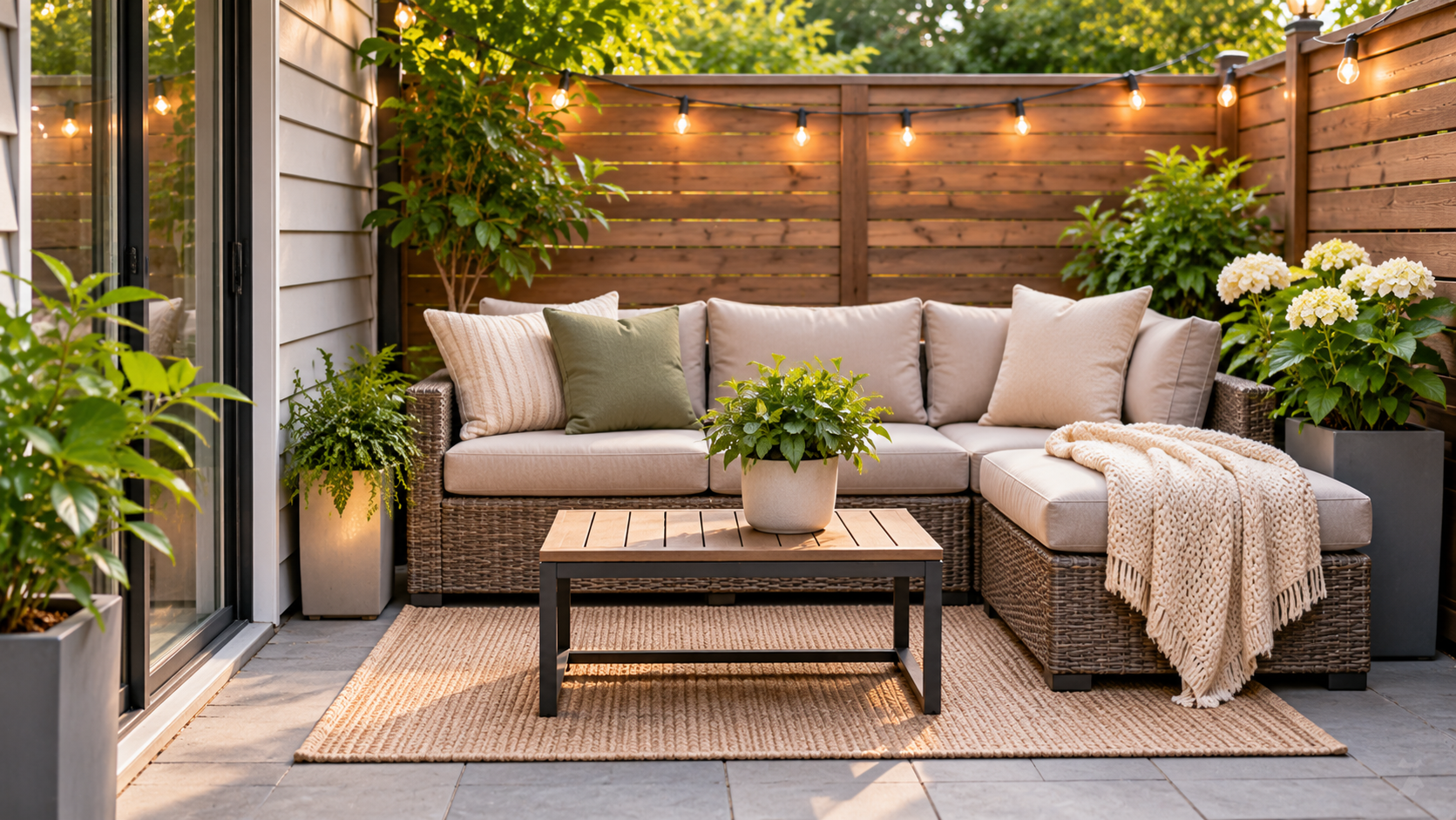
Tuck an L-shaped arrangement into a corner using armless chairs and one corner unit. This leaves the rest of the patio open and creates a cozy, conversation-friendly nook.
The Face-to-Face Conversation Layout
Place a loveseat on one side and two chairs facing it. Add a small table or ottoman between them. It’s simple, balanced, and great for chatting.
The Loveseat and Two Chairs Layout
Instead of a full sofa, choose a loveseat with two chairs angled toward it. You get seating for four without a bulky footprint.
The Flexible Chaise Layout
If lounging matters most, consider one or two chaise lounges with a small side table between them. This works well on sunny patios and near pools.
Not sure which brand fits your style? Read Woodard vs Telescope Casual vs Finch.
Step 4: Pick Pieces That Work Harder
On a small patio, every piece should earn its place. Choose armless chairs and corner units for flexible seating, ottomans that work as tables or extra seats, side tables instead of large coffee tables, and storage pieces that hide cushions and clutter. Multi-use furniture keeps the space open and functional.
Armless Chairs and Corner Units
Armless pieces take up less width and can be pushed together or pulled apart. Corner units help create clean L-shaped layouts.
Ottomans That Double as Tables or Seats
Add a tray, and an ottoman becomes a coffee table. Remove the tray, and it becomes extra seating for guests.
Side Tables Instead of Big Coffee Tables
One or two small side tables can replace a large coffee table and free up valuable floor space.
Storage That Hides Cushions and Clutter
Storage benches or deck boxes keep cushions, pillows, and outdoor toys out of sight. Less visual clutter makes small spaces feel calmer.
Explore our deep seating collections, Woodard deep seating, and tables collection to see options in person.
Step 5: Add Shade, Warmth, and Light
Shade, warmth, and lighting turn a small patio into a true outdoor living room. Umbrellas, canopies, and pergolas create comfortable shade. Patio heaters can extend cooler evenings. Soft lighting adds atmosphere. Before adding any fire feature, check local rules, since some towns require distance from homes and structures.
Shade Options for Small Patios
- A cantilever or offset umbrella keeps the pole out of your seating area
- A canopy or shade structure covers more space without crowding the floor
- A pergola defines your outdoor room and adds architectural interest
Browse our patio umbrellas, EZShade canopies and curtains, and pergolas.
Staying Warm on Cool Evenings
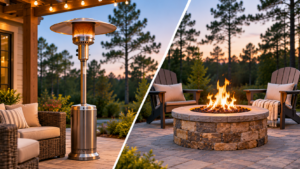
Sandhill evenings can turn chilly in fall and early spring. Throw blankets and patio heaters can keep your outdoor room usable longer. See our guide to patio heaters vs fire pits for winter comfort.
A note about fire features: Small patios sit close to the house, which matters for fire safety. Published rules in both Pinehurst and Southern Pines have called for portable fire features to be kept well away from structures and combustibles, with distances like 15 feet cited for portable devices. Always check with your local fire department before adding a fire pit or fire table to a small patio. For more, read our fire pit safety tips.
Comparing fire options? Read gas vs wood-burning fire pits in NC.
Lighting That Sets the Mood
String lights, lanterns, and solar path lights add warmth without taking up floor space. Hanging lights overhead keep the ground clear.
Step 6: Make a Small Patio Feel Bigger
You can make a small patio feel bigger by using a cohesive color palette, defining the space with an outdoor rug, adding vertical planters, choosing low-profile and open-frame furniture, and keeping walkways clear. These visual tricks reduce clutter and help the eye see more open space.
- Stick to a simple color palette. Two or three coordinating colors feel calmer.
- Use an outdoor rug. It defines the “room” and makes the layout feel intentional.
- Go vertical. Wall planters and tall pots add greenery without using floor space.
- Choose low-profile pieces. Lower backs keep sightlines open.
- Try open-frame designs. Furniture with visible legs feels lighter than solid bases.
- Keep walkways clear. Open paths make the whole patio feel larger.
See frame and fabric combinations on our patio furniture color options page.
Sandhills Tips: Weather, Pollen, and HOA Rules
Sandhills patios face heat, humidity, spring pine pollen, and summer storms. Choose weather-resistant materials, easy-to-clean fabrics, and pieces that won’t blow around easily. If you live in a community with an HOA, check guidelines on structures, shade, and colors before you buy or build.
Choosing Materials for Heat and Humidity
Aluminum, poly lumber, and quality outdoor fabrics handle humid summers well. Learn more in poly lumber vs aluminum vs teak in North Carolina.
Managing Spring Pine Pollen
Each spring, pollen coats everything yellow. Choose smooth surfaces and removable cushion covers that are easy to rinse and clean.
Checking HOA and Community Guidelines
Many Pinehurst and Southern Pines neighborhoods have rules about pergolas, shade structures, and visible colors. A quick check now can save headaches later. Read HOA and community outdoor furniture in NC for what to know before you buy.
Common Small Patio Mistakes to Avoid
Common small patio mistakes include buying furniture before measuring, choosing oversized deep seating, using too many small pieces, blocking doors and walkways, skipping shade, ignoring storage, and adding fire features without checking local rules. Avoiding these mistakes helps your patio feel comfortable and usable every day.
- Buying furniture before measuring
- Choosing seating that’s too deep for the space
- Using too many small pieces that create clutter
- Blocking doors, steps, or main walkways
- Skipping shade on sunny patios
- Forgetting storage for cushions and accessories
- Adding fire features without checking local rules
Ready to Plan Your Small Patio Living Room?
A small patio can become your favorite room. It just needs the right plan and the right pieces.
Visit GreyFox Outdoor at 225 W Morganton Rd, Suite C, in Southern Pines to sit in different sizes and styles. Explore Telescope Casual, Casual Comfort, and our sling and Adirondack collections. Request a quote or call (910) 725-0394.
Frequently Asked Questions About Small Patio Layouts
How do I arrange furniture on a small patio?
Start by measuring your usable space and marking doors and walkways. Use tape to outline furniture before buying. Choose a layout that fits your patio’s shape, like an L-shape in a corner or seating along a long wall, and leave clear paths for walking.
Is a sectional too big for a small patio?
Not always. A compact modular sectional made of armless chairs and a corner unit can fit many small patios. Check seat depth, overall length, and walkway space first. On very small patios, a loveseat with two chairs may feel more open.
How far should a coffee table be from a patio sofa?
A common starting point is about 14 to 18 inches between seating and a coffee table. That gives enough room for knees while keeping drinks within easy reach. On tight patios, small side tables or an ottoman with a tray can work instead.
How much walkway space do I need on a patio?
Many design guides suggest about 36 inches for main walkways, so two people can pass comfortably. Secondary paths, like behind seating, often work with about 24 inches. Always keep doors, steps, and grill areas clear for safety.
Can I have a fire pit on a small patio?
It depends on your local rules and patio size. In Pinehurst and Southern Pines, published rules have called for portable fire features to be kept well away from homes and structures. Check with your local fire department before adding any fire feature to a small patio.
How can I make a small patio feel bigger?
Use a simple color palette, define the space with an outdoor rug, choose low-profile and open-frame furniture, add vertical planters, and keep walkways clear. Hanging lights overhead and storage for cushions also reduce clutter and make the space feel more open.
Create Your Outdoor Living Room With GreyFox Outdoor
Tom and Linda sold their old oversized set. They measured their patio, taped out a plan, and chose a compact modular layout with two armless chairs, a corner unit, and an ottoman that doubled as a table.
Now there’s room to walk. The door opens freely. And on cool fall evenings, they sit outside with blankets, watching the sunset over the pines.
Same patio. Better plan. A whole new room.
GreyFox Outdoor helps homeowners across Southern Pines, Pinehurst, and Moore County design outdoor spaces that fit the way they live. Browse our patio furniture, get inspired by our outdoor furniture gallery, or learn more about GreyFox Outdoor.
Call (910) 725-0394, contact our team, or find us on Google Maps. Let’s turn your small patio into your favorite room.